Seriously, this guy… this guy is full of advice for a writer who’s having trouble getting started.
He’s not writing, he’s painting, but… okay, like, he can sit there and talk about geology and the diffusion of light and make it clear that he knows what a mountain is and he knows what goes into the interplay of light and perspective, and then you’ll watch him smear some black paint on top of a still wet canvas with a thin metal wedge, and then take a brush and push it downwards so that it mixes with the base in such a way that it ends up lighter at the bottom and eventually just fades into the background.
And then he’ll take some titanium white paint and do the same thing to add snow and light, and you’re thinking… “But… interplay. Geology. Perspective.” and he’s just pushing paint around, talking about figuring out where the north slope lives and how there are no mistakes, just happy little accidents and then he steps back at the end and holy moly, it looks like he painted a mountain.
It doesn’t look like he pushed paint around for ten minutes, it looks like he looked at a real mountain somewhere and copied it.
Is there a real mountain that matches the painting? No. Could he use this method to exactly replicate an actual mountain? No. But he made a mountain that looks real enough, and even if he didn’t have 100% control over the final look of it, he conjured it out of his imagination.
This is the trick that more writers need to learn. It’s possible to create a story or even a whole book through meticulous planning and careful construction, but… most people can’t do that. It’s not that we’re not willing to put in the work, it’s just too easy to get stuck. Too easy to never leave the “Well, I’m still worldbuilding/researching” stage. Too easy to write oneself into a corner or get bogged down in the details.
So this is my advice today for fiction writers:
Learn how to speed paint.
Learn how to work wet on wet.
Learn how to push paint around on the edge of a knife.
Learn how to figure out where things want to live by feel and how to allow for happy little accidents.
There will be places for fine details and intricate sketches. But when you’re staring at a blank canvas and you have no idea where to start… paint the whole thing blue and start scraping up some mountains.
Quick, broad strokes. That’s all it takes to get you started. Quick, broad strokes and a few happy accidents.
Reblogging for myself.
Useful advice, especially this –
It’s possible to create a story or even a whole book through meticulous
planning and careful construction, but… most people can’t do that. It’s
not that we’re not willing to put in the work, it’s just too easy to get
stuck. Too easy to never leave the “Well, I’m still
worldbuilding/researching” stage. Too easy to write oneself into a
corner or get bogged down in the details.
Until you’ve created a sky and a landscape there’s no need to research the shape of leaves on trees, and even less need to find out how their veins wiggle. If something that minuscule is an important plot point – and if it’s too minuscule it’ll start to feel like a Deus ex Machina – come back to it later once the story is complete.
I speak from guilty rivet-counting experience here. Four carefully-researched chapters out of a projected fifteen Did Not Make A Finished Book – and perhaps never will, because I got so embroiled in tweaks and polishes that I literally lost the plot and spoke (or thought) theEight Deadly Words. Bad enough when a reader says them; if it’s the author, there’s a problem. That material is now in the “check this later maybe” folder that’s the Dropbox equivalent of shoved to the back of the drawer. At least it hasn’t been deleted. (Never Delete Anything.) Be warned by me.
(It’s why so many of my arms and armour (etc) posts have a slant towards use in writing, and why you’ll often see observations like “if specific – a 7.62mm Nagant revolver with a Bramit suppressor – isn’t vital, vague – a silenced handgun – works fine with less chance of error”.)
@dduane often uses and mentions C.J. Cherryh’s “ten-item-shopping-list” technique – ten sequential incidents to take a story from “Once upon a time” to “The End”, and ten smaller incidents inside each larger one to take a chapter from its start to its finish. That’s what will happen to he things at the back of the drawer when/if they come out again.
Given how many novels DD and CJ have written, it’s a technique worth noting even if outlines aren’t your thing.
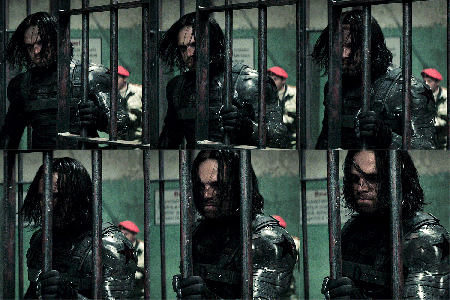
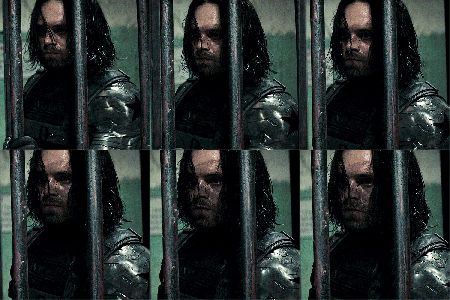
Look me in the god damn eyes and tell me that there isn’t a hint of ‘oh shit, what have you idiots gone and done?’ in his expression in the bottom gif. I think it’s fair to say that the Soldier must be at least semi aware of what he is and what he’s capable of, he’s not the totally unquestioning blank state many of us maybe thought. He seems to show subtle little emotions, such as when he looks torn af when he’s given his orders at the beginning of the movie, and it honestly intrigues the hell out of me. For him to realize that these new super soldiers are, in his own words, worse than him is fascinating to me and makes me wonder how much more he was aware of.
TIL that a cat once co-authored a physics paper. In 1975, a physicist had just finished writing a paper and was ready to publish but realized that he had used ‘we’ instead of ‘I’ throughout, despite being the sole author. Not wanting to edit the paper, he listed his cat, Chester, as a co-author.
Ok but the best part is, physicists loved the joke. When people called the author’s university and he wasn’t available, they’d ask to speak with the co-author instead. The author issued a limited number of copies of the article signed by both authors. (Chester’s was obviously a pawprint.) And to this day, physics papers will often have F.D.C Willard (Felix Domesticus, Chester Williard [Willard was the author’s father’s name]) mentioned in the footnotes thanking his “useful contributions to the discussion”.
But still interested in feeding yourself? What if I told you that there’s a woman with a blog who had to feed both herself and her young son…on 10 British pounds ($15/14 Euro) per week?
Let me tell you a thing.
This woman saved my life last year. Actually saved my life. I had a piggy bank full of change and that’s it. Many people in my fandom might remember that dark time as when I had to hock my writing skills in exchange for donations. I cried a lot then.
This is real talk, people: I marked down exactly what I needed to buy, totaled it, counted out that exact change, and then went to three different stores to buy what I needed so I didn’t have to dump a load of change on just one person. I was already embarrassed, but to feel people staring? Utter shame suffused me. The reasons behind that are another post all together.
AgirlcalledJack.com is run by a British woman who was on benefits for years. Things got desperate. She had to find a way to feed herself and her son using just the basics that could be found at the supermarket. But the recipes she came up with are amazing.
You have to consider the differing costs of things between countries, but if you just have three ingredients in your cupboard, this woman will tell you what to do with it. Check what you already have. Chances are you have the basics of a filling meal already.
Bake your own bread. It’s easier than you think. Here’s a list of many recipes, each using some variation of just plain flour, yeast, some oil, maybe water or lemon juice. And kneading bread is therapeutic.
She has a book, but many recipes can be found on her blog for free. She prices her recipes down to the cent, and every year she participates in a project called “Living Below the Line” where she has to live on 1 BP per day of food for five days.
Things improved for me a little, but her website is my go to. I learned how to bake bread (using my crockpot, but that was my own twist), and I have a little cart full of things that saved me back then, just in case I need them again. She gives you the tools to feed yourself, for very little money, and that’s a fabulous feeling.
Tip: Whenever you have a little extra money, buy a 10 dollar/pound/euro giftcard from your discount grocer. Stash it. That’s your super emergency money. Make sure they don’t charge by the month for lack of use, though.
I don’t care if it sounds like an advertisement–you won’t be buying anything from the site. What I DO care about is your mental, emotional, and physical health–and dammit, food’s right in the center of that.
If you don’t need this now, pass it on to someone who does. Pass it on anyway, because do you REALLY know which of the people in your life is in need? Which follower might be staring at their own piggy bank? Trust me: someone out there needs to see this.
Reblogging for all the impoverished students. Jack is the breadline queen. And if you don’t need this – donate to your nearest food bank, stat.
Reblogging for students, working folks, and everyone who’s ever had to choose between essentials at the store because you can only afford milk OR bread, not both.
Always reblog because these are AMAZING and Jack is awesome.
(Also worth noting: Jack identifies as nonbinary and I *think* uses they/them pronouns. Due to internet dickassery, this is difficult to google, sadly.)





 Tumblr Exodus