Anything by Greg Bordowicz: Just a fantastic nonfiction writer in general. The AIDS Crisis is Ridiculous and Other Writings (buy here) is an incredibly well written book.
Academic Reading: Fear of A Queer Planet. Edited by Michael Warner (download here or buy here) Specifically see the essays by Patton and by Freeman and Berlant.
Primary Source: Randy Shilts And the Band Played On. Primary resource with (obviously) outdated information (for example, the Patient Zero myth). But important historical artifact.
Biography and Memoir:
David Wojnarowicz
Fire in the Belly:The Life and Times of David Wojnarowicz by Cynthia Carr (buy here)
Close to the Knives: A Memoir of Disintegration by David Wojnarowicz (buy here)
Vito: documentary on Vito Russo on Netflix. (bonus: adaptation of Russo’s book on queer portrayals in classic film, The Celluloid Closet)
Bonus: not AIDS related, but The Life and Times of Harvey Milk is on Hulu. It does a good job explaining the political climate in San Francisco following Milk’s murder and establishing the milieu from which the San Francisco AIDS crisis emerged.
Reluctantly recced: How to Survive a Plague. Well-done documentary that provides a great deal of historical background and information, but over-emphasizes the role of white men in ACT-UP (though interestingly enough, not Kramer). I.e., aggrandizes Peter Staley.
Angels in America by Tony Kushner. Rent HBO adaptation here. If you have a Scribd subscription, read here. Teachers’s Resource Packet with Background Information
Sarah Shulman People in Trouble (buy here) Scribd here note: much of Rent was plagiarized from Shulman which is but one reason it is not on this list. Further reading: Shulman’s Stagestruck: Theater, AIDS, and the Marketing of Gay America (buy here)
Sam never saw himself as a hero – not even when his father
spat the word at him, the night Sam’s family took him out for dinner to
celebrate his summa cum laude and
discovered he’d applied for the USAF instead of the MA/PhD.
“Just an act of rebellion,” his mother said, because Sam’s
mother had fifteen books on the ‘feminine in the masculine’ and ‘understanding
Oedipal mirroring in a post-structural world’ and she’d written the last three.
“Be glad he didn’t join a gang, Gerald.”
Sam was handpicked by the government halfway through Basic Training,
plucked from ranks of exhausted young men and one woman – the creation of masculinity through the oppression of the feminine,
his mother would have said – and his new CO clapped him on the shoulder. “Your
parents must be proud,” he said, and Wilson didn’t bother to inform the man
that his parents expected him to come home with tattoos and bricks of cocaine.
He went home with a tattoo, the Falcon unit crest over his
bicep, virtute alisque above it, No One Comes Close in the scroll below.
His father sniffed and went back to his medical journals, and his mother asked
if there had been a ceremony, perhaps some ritual consumption of alcohol in
this process of manhood.
Sam’s mother had sat them all down with articles on womanhood
when Sam’s older sister got her first period. They had celebrated the new stage
in her life and each handed her something useful to help her on her path –
Celeste had muttered to Sam that new
parents would be useful, but no one else heard – and Sam had never been so
glad to be a boy, until his mother had suggested they hold a similar ceremony
for everyone’s sexual awakening.
Reilly, though. Reilly was always meant to be a hero.
Michael O’Reilly was built like Captain America, over six feet tall with dark
hair and a broad grin, bright eyes that crinkled at the corners even when he
wasn’t smiling, dimples in his cheeks and a booming voice. There was something
about Reilly’s face that made people take a second look, that kept the whole
base staring for a little too long.
Reilly had designed the tattoos; he’d enlisted fresh out of
high school, five years in to Sam’s one, planning to fly until his wings or his
heart gave way. His older brother had joined the Marines, like their Dad, and
Reilly had gone for the Air Force to honor the grandfather who’d died over Nazi
Germany. (At least, that’s what he told everyone who asked. After meeting
Reilly’s older brother, Sam’s degree in psychology and Dr. Annette Cole Wilson’s
books suggested that Reilly had joined the Air Force to harass his water-bound
brother from the sky.)
Sam went home with Reilly for Thanksgiving the second year,
because the first year Reilly had talked nonstop through long days in theater
about his mother’s pie, and the Wilson family didn’t celebrate holidays that
reified the genocide of minorities. (In fourth grade, Sam’s teacher had asked
them to write an essay on Valentine’s Day, and Sam Wilson had argued that it
glorified violence done to corporate Italian bodies. Ms. Kupperman had not been
impressed.) Mrs. O’Reilly had met them at door, completely dwarfed by her
husband’s bulk and her American sons.
Embarrassingly, Sam had stood there with his mouth open for
longer than the son of Drs. Cole Wilson should have, shocked to see Reilly
sweep the tiny, smiling Asian woman into his arms and shout, “May!” (It was
another year and several more dinners before Sam learned that Mrs. O’Reilly’s
name wasn’t ‘May,’ and that he’d been calling Reilly’s mother ‘mẹ’
since they’d first met.)
“I told you my parents met in ‘Nam,
birdbrain,” Reilly laughed, taking Sam’s speechlessness with his usual grin. “What
did you think I meant?”
“I thought she was a nurse!” Sam
defended himself, and felt his cheeks heat up when Mr. O’Reilly winked and
said, “Oh, son, she was.”
It turned out that Mrs. O’Reilly made a mean Thanksgiving
dinner and seemed unconcerned with the commemoration of cultural extermination.
“It’s a good dinner,” she told him, when Sam asked, patting his cheek and
spooning more gravy onto his plate. “All my kids home. I show you pictures
later, my boys in school play. Mike was big turkey.”
Michael O’Reilly had indeed been a large turkey in his first
grade play. Michael O’Reilly had been a hero, from the insults he had fought as
a child – Reilly and his brother on the playground, slant-eyed kids with the mother
who couldn’t talk right, just like Sam had been the black kid in his private
school, the kid that didn’t know how to be black when their mother made them
volunteer at the youth center when he was a teen – to the wars he had tried to
end at just eighteen.
The thing about heroes, though? They never stick around long
enough to collect the medals they earn. Sam had stood on the stage next to
Reilly’s brother, both of them buttoned into their military best and choking
for air, the wrong Reilly accepting the cold, metallic honors his little
brother had earned while their mother sobbed against Mr. O’Reilly’s shirt.
Sam meets Steve Rogers in July, goes on the run a week
later, phones home from a burn phone to let his parents know he’s all right.
Annette Cole Wilson wants to know if this rebellion is to reinforce the
boundaries of masculinity in a militaristic setting, and Gerald Wilson tells
them to stop by and stock the first aid kit before they go.
In November, he puts down his gun and shakes off his wings
and brings the team to mẹ’s. “Where
are we going?” Steve asks, broad shoulders and a hero’s bright eyes.
“To look at some pictures of a big
turkey,” Sam tells him, rubbing at the wings of his tattoo. “And eat some pie.”
Mrs. O’Reilly meets them at the door,
light as a feather when Sam scoops her into his arms, a soft smile for the pack
of fugitives behind him, vivid aubergine lipstick and her son’s twinkling eyes.
“You stay for dinner,” she commands, beckoning them in, reaching up to pat Sam
on the cheek, rubbing her thumb at the damp spot under his eye. “All my kids
come home.”
So, Jewish languages other than Hebrew are all endangered, and even Hebrew many of us don’t speak. So, in honor of Preservation Day, I’ve gathered a bunch of language resources, and hopefully we’ll be able to learn our heritage languages more easily, as well as Hebrew, both biblical for the Torah, and modern for trips (or flight, as necessary) to Israel.
I’ll start with a request for help from the people who DO know these languages: the website duolingo has both Yiddish and Hebrew projects that need people to help them work. It seems like a very effective language learning site, and it would help us preserve our languages. And if someone capable of doing so started up a Ladino project, or any of the various Judeo-Arabic languages (I apologize, I know basically nothing about them) it would be great!
Next up is My Language Exchange. This is a very versatile site that seems mostly to be about matching up people learning each others’ languages as pen pals. There’s a little bit more structure, but it’s only available for the biggest languages. However, and this is a BIG plus, it has people who speak Hebrew, Yiddish and Ladino all, and I’ve had trouble finding any websites that even acknowledge Ladino.
Ancient Hebrew
So, for all that I know nothing about Judeo-Arabic and little about Ladino, Ancient/Biblical Hebrew is pretty mysterious to me. I never went to Hebrew school, so anything here is good. Right now, the only thing I have is a couple of posts from an old, abandoned tumblr (to an extent, it’s been replaced by tumblrs like littlegoythings, returnofthejudai and jewish-privilege)
So, here’s a post about how Hebrew was written and pronounced in ancient times compared to today, and another on German’s influence on Hebrew pronunciation, that might fit better in the next section.
Modern Hebrew
Now, Modern Hebrew, being the language of an actual, geopolitically important country is the easiest to find resources for. In addition to Rosetta Stone, which is quite expensive (though my Dad swears by it, in six months he’s reading Israeli newspapers) there’s a free site run by them, Live Mocha, which includes Hebrew.
Thanks to all the resources available, Hebrew language learning resources have already been collected. A couple of places that do that are Omniglot, Fluent Forever, and Ecott. And then there’s the online parts of the Hebrew programs at UT Austin and Yale.
And now, into the Diaspora! There are tons of Diaspora languages, but not all of them have their own names. The biggest one, though, is Judeo-German, better known now as Yiddish. It’s been a very active language, and had a cultural golden age in the late 19th and early 20th centuries.
And then, of course, there’s YiddishPop! I haven’t looked in detail at it, but YiddishPop seems to be all about learning Yiddish in a fun online environmentm, with lots of games and stuff.
Ladino
Ladino, unfortunately, doesn’t have nearly the support that Hebrew and Yiddish do. Fortunately, while I was looking for resources, @concentratedridiculousness responded to me and made a nice big post about Ladino, though most of the resources aren’t online.
i’ve seen a lot of variations on this argument pass my dash ever since that cacw empire article came out, so i’m just gonna say it: it is not harder and better and somehow more purer to portray a platonic male friendship on screen than it is to make the relationship romantic. it’s not. the history of media is full of guys who love each other and would do anything for each other and then go home to their wives, because well obviously they’re not gay.
“romance is just an easy shorthand for intimacy and trust.”
please. please send these easy shorthand gay relationships my way. what universe do you live in that gay people can hook up easily on-screen and the audience reaction is “what a cop-out, they’re just doing it to avoid developing their friendship.”
listen. heterosexual romance is often an easy shorthand for intimacy and trust. this works because there’s an expectation – both on part of the filmmaker and the presumed audience – that heterosexual romance is normal and part of the background radiation of everyday life. and anyone makes a movie where the male and female leads hook up, without much build-up or development of their relationship, they then strengthen that expectation in a self-perpetuating feedback loop.
gay romance does not have the same cultural history. the default assumption is in fact that same-sex leads will not hook up unless they live in the gay/lesbian genre. platonic male friendship is, in fact, the easy way out.
it’s absolutely homophobic to say a gay romantic relationship would somehow lessen a bond of friendship. and i mean this in the kindest of ways, because it’s not the same kind of homophobia that leads to gay people being physically attacked, or laws being written to actively restrict people’s rights for the fact of being gay. it’s a low-grade, pervasive homophobia that results when the speaker doesn’t conceptualize gay people as a part of a normal, everyday milieu. that a character being gay has to be narratively justified in some way (as if gay people around the world don’t have to justify their right to exist every single day!); that a gay relationship is somehow “pandering” and “inorganic”, because the normal, natural – straight – audience could never really relate to a gay relationship.
look. we are all shaped by cultural expectations. it doesn’t make someone a bad person if their mental conception of “an intense relationship between two guys” defaults to “friendship” instead of “romance”. but responding to any challenges to that paradigm by extolling the virtues of same-sex friendship and ignoring the long history of gay relationships in media being censored and sanitized and othered? yeah. that’s homophobic.
Agreed. If it were really so “easy” to say they were lovers, it would have been done already.
The use of the word “brotherhood” as a counter to gay relationships has really started to bother me.
Brotherhood has become a more polished “no homo,” apparently to the point that two male characters can have a “love story” on screen and still be totally straight. They could say the characters are “just friends,” but they have to go all the way to “brothers” to make sure the relationship can be as emotional as they want with no gay repercussions. When I see this, I feel like it sets up a dichotomy of queer vs. familial, where “brotherly love” is held up as the safe, natural reading, and a queer reading becomes even more perverse by contrast.
I also hate when people will bring up the constraints men put on their friendships. “This is such an important depiction of male friendship. Men are never allowed to show this amount of love or vulnerability with their buddies.” The implication, of course, being that to turn it into a gay romance would be to cheapen it. That it’s more important to have yet another statement about the beauty of masculine friendship instead of queer representation. Look, buddy, it’s not my fault men won’t hug each other. And what’s this about them not being allowed? Men are absolutely allowed to hug each other, to be open and vulnerable and demonstrative with their friends. You know why they don’t? Because they’re afraid someone will think they’re gay. Because male friendship is acceptable and male romance isn’t.
When I explain cultural misappropriation to children, I use the example of The Nightmare Before Christmas.
It’s effective because especially for children, who don’t have enough historical context to understand much of the concept, you can still fully grasp the idea.
There was nothing wrong with Jack seeing the beauty and differences in Christmas town, it’s when he tried to take what is unique about Christmas town away from those it originally belonged to without understanding the full context of Christmas things is when everything went wrong.
When Jack tries to get the folk of Halloween town to make Christmas gifts for children, etc., children understand that the Halloween town folk do not have the full context for the objects they are making, and they are able to see that the direct repercussions and consequences are very harmful.
what i like about this is the implication that if jack had taken the time to understand christmas town, bringing christmas to halloween town would not have been harmful. that’s how it works, folks. cultural sharing is GOOD, it’s only misappropriation when it’s done in ignorance and disrespect.
So it’s not just accidentally removing things form their context; he has intentionally disregard the meaning of the rituals he purports to be recreating, making them more fun for the recreaters but not like what the rituals are supposed to be and without the related significance.
This is the best way to conceptualize the wrong way to share culture I have ever seen and I think I finally get where people are coming from when they talk about “cultural appropriation.”
This is an EXCELLENT explanation through example!
I’ve seen this post go around before and reblogged it, but this time, the distinction between “get it” and “have it” really jumped out at me.
I never leave the house without my collection of magic items:
KEYS—allow walking through walls at predefined locations.
GLASSES— remove one disability.
WALLET—can be converted into practically anything, up to a finite total monetary value.
PANTS—vastly decrease risk of getting arrested.
SHOES–allow walking over surfaces which are too hot or rough.
BOOK-allows temporary travel to alternate reality
PURSE–increases the number of items that can be carried at once.
COAT-allow survival at below freezing temperatures.
PHONE-allows at-will instant communication with pre-selected willing sentient beings, as well as many other advanced functions at higher levels.
NOTEBOOK-stores finite number of memory spells (eg Invocation of Grocery Shopping) and the like and allows swift recording of quest discoveries. Must be used with PEN.
HAIR TIES–provides bonuses to Disguise and Perception. Can be combined with BOBBY PINS for additional bonuses.
MAKE UP – provides the possibility to become someone else.
LIGHTER – low-level fire magic item with a large number of charges.
TISSUES – remove status effects, improve stealth.
DOG – companion animal. provides protection and +charisma
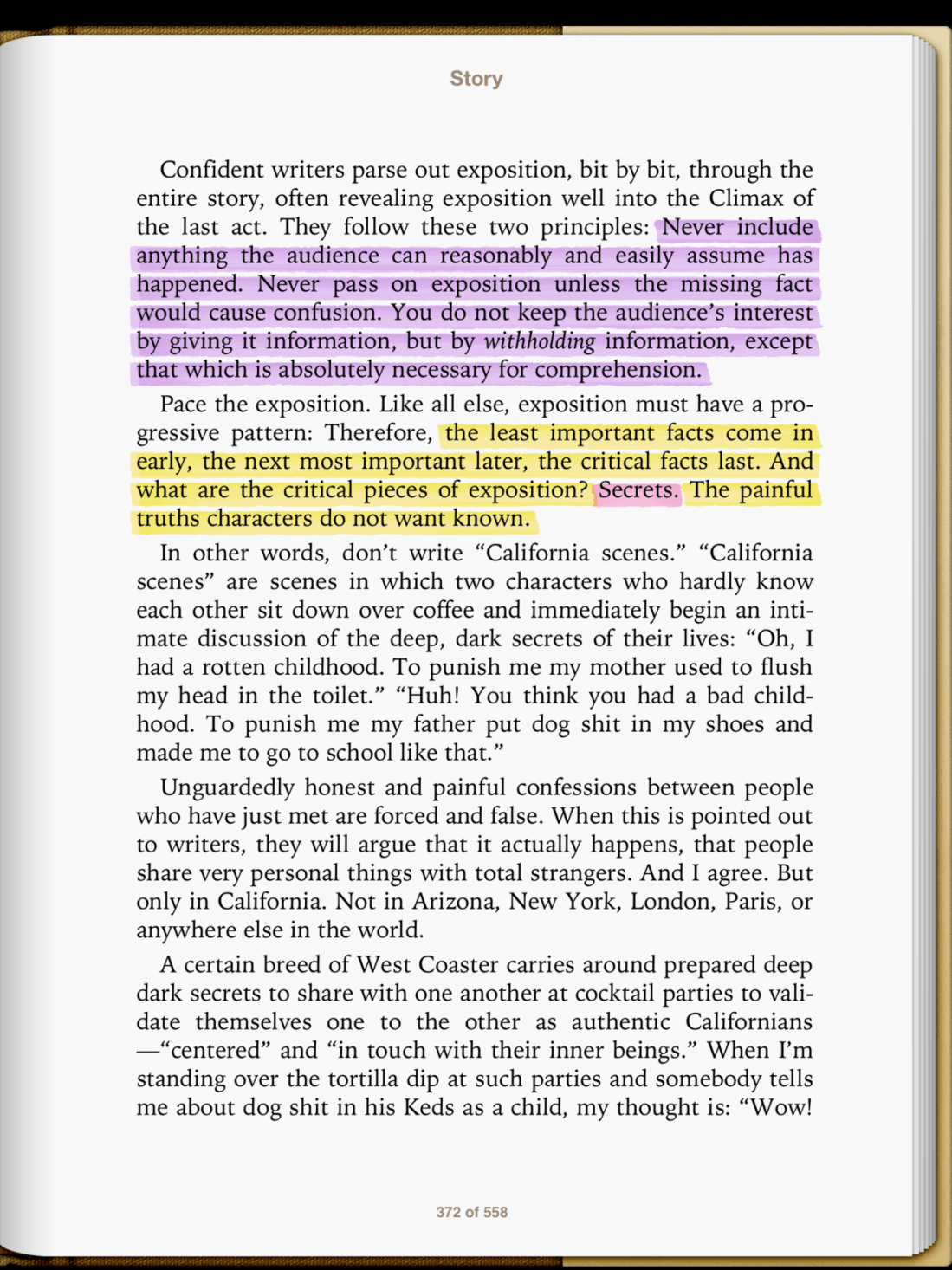
THIS IS ONE OF THE MOST IMPORTANT AND VALUABLE LESSONS YOU CAN LEARN AS A WRITER. I SAY THIS AS A READER AND A PROFESSIONAL GENRE EDITOR.
This is really a thing I’m struggling to learn! I’m like a drunk at a party: if it’s on my mind, I have to tell it to you.
I would pedantically add, though, that you can totally write characters who confess deep dark secrets to near-strangers. However, people who do this, in my experience (I have, in fact, spent a lot of time in California) are covering up their actual deep dark secrets with a smoke-screen of apparent secrets. So Californians aren’t really the exception they appear to be.
(Also: in fanfic, sometimes we do shit we know breaks the “good story rules” because it’s fanfic and we want to. Just saying.)
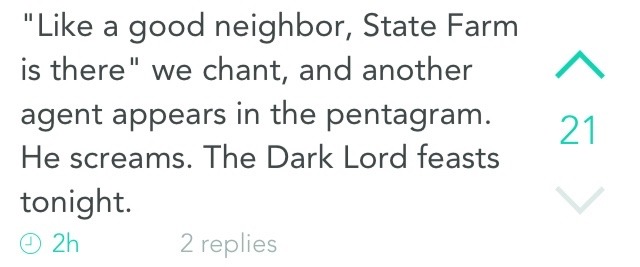
“Like a good neighbor, State Farm is there,” and another one appears. And dodges the downward sweep of claws, darting to the side, bouncing off the pentagram’s barriers, and tripping over the demon’s tail. “In the Vatican!” she cries out as she moves, using the State Farm Agent summoning charm to modify the situation as she was taught, and mentally thanking her trainer for expecting her to be fast enough to do it on the first incantation.
Most State Farm agents, when they run into trouble, have to get the customer to do the jingle a second time. That guy with the buffalo was lucky.
The magic takes hold, and she materializes in the aisle of St. Peter’s Basilica, still holding the demon by the tail, in the middle of Sunday morning Mass. The music clatters unprofessionally to a halt as laypeople, deacons, priests, monks, nuns, and the Pope all turn their attention to the surprised demon whose fifth course of dinner has turned, unaccountably, into a visit to one of his least favorite places on Earth.
There is chanting in Latin, and vaguely cross-shaped gestures, and clouds of incense, and the demon vanishes in a puff of smoke, whether from the efforts of the clergy or of his own volition no one can say. The Agent doesn’t wait, fleeing towards the doors and escaping in the confusion.
She gains the exit and walks, purposefully, toward Rome proper; there, she ducks into the nearest alley. A burner cell phone comes out of one of the less-used pockets of her purse, and she dials a number from memory.
“Allstate,” says a smooth masculine voice after three rings.
“State Farm,” she answers. “I’m calling in a favor.”
“Yeah?” Interest. “What sort?”
As she talks she’s pulling out her smartphone, keying an app that was activated by the summoning, and pulling up the policyholder data that enabled the incantation to work.
“Insurance fraud,” she said, and can almost hear teeth sharpening on the other end of the line. She gives him the name, the address, the policy number. “Someone needs some mayhem.”
“That’s my name,” the man says.
She smiles. “Someone needs all the mayhem.”
He chuckles. Slow. Evil. Even with the echoes of demonic laughter ringing in her ears, she’s impressed. “Don’t worry,” he says, almost purring.
“You’re in good hands.”
OH MY FUCKING GOD I just read insurance commercial fan fiction and it was so good, bless you, I’m going to remember this day forever.
IT COMES BACK TO ME! *preens*
Part 2:
It’s not too long later—State Farm will occasionally loan out their teleportation trick, though Heaven help anyone who tries to use it to compete with them—and the man they call Mayhem is squatting next to a demonic circle with tacky half-dried blood under the leather soles of his shoes. Whoever dispelled the circle didn’t do a good job of it; the ring is still faintly smoldering and Mayhem has already singed his fingers on the air above it. He’s in the basement of a house with a State Farm homeowner’s policy, waiting for his partner in, erm, crime, to show up.
“Oh, good heavens.” He smiles at the sound of someone hopping delicately back, then carefully tiptoeing through the mess. Demons are messy eaters, and Flo’s wearing all white.
She steps gingerly over what might be most of a femur, looks from circle to Mayhem to—is that half a skull on the floor? “Freaky. Whaddaya need?”
“Tech,” he says. “State Farm knows the homeowner summoned them, but the Agent reported at least five people present. Maybe six. She isn’t sure, what with being busy evading a demon inside a very small space with zappy walls.”
Flo’s already got a—where does she get those from anyway? a cardboard box in her hands. Mayhem watches as she unfolds it, refolds it, and ends up with something significantly bigger, shaped like a satellite dish. He tries to watch how she does it; they may be working together, but they’re still rivals and his own higher-ups will be very interested in the latest whatever-it-does that Progressive has come up with.
A blue glow lights up the concave side. Mayhem is pretty sure cardboard doesn’t work that way. Flo makes a pleased sound, and starts rattling off names, addresses, policy numbers.
Impressed, Mayhem asks, “How the fuck?” If Progressive is developing some sort of superspy technology, well, that’s kind of ominous.
Flo grins and looks embarrassed. “I, ah, have occasional dealings with a couple guys from That Other Insurance Company. One of them knows someone who knows someone who works in quality control for the Infernal Realms, and it turns out Hell monitors all their summoned manifestations for safety purposes. His contact got me the list of who was there.”
Mayhem nods. He’s had occasional encounters That Other Insurance Company himself. Bland, grey-suited, timid men who are even worse spies than they are insurance agents. “Wait, Hell has a quality control department?”
“And all other forms of administration,” Flo says. “I understand it’s to generate maximum paperwork. It is a place of punishment, after all.”
Mayhem actually winces. “That’s definitely hellish. All right. The Agent who called me in is flying back from Italy and should meet us in a few hours. Should give us plenty of time to plan an attack. Are they all State Farm customers?”
“Just the one,” Flo replies, folding her toy up, and Mayhem watches with vague envy as it becomes a giant sword. “One Allstate, one Progressive, one Geico, two Farmers. We gonna invite anyone else to the party?” She hopes so. Mayhem’s precision strikes on any sort of insurance fraud perpetrators are the stuff of legend, and the Farmers guys would bring in enough absurdity to make it a work of art.
Mayhem’s grin is something that ought to haunt her nightmares. Instead, she finds herself matching it. “Yes,” he says. “Let’s.”
Part 3:
The sun is just a
suggestion behind the horizon, but the morning traffic jam is already
clogging up the freeways by the time Mayhem and Flo leave the scene
of the crime. Flo is driving, weaving her motorcycle expertly through
the sea of zombie commuters, and already some jackass in a
twenty-year-old Honda has rolled down his window to sneer at Mayhem
for riding behind a woman and in the process taken his eyes off the
road long enough to rear-end a state trooper.
By the time the sun
is peeking over the edge of the world, the freeway has been exchanged
for fast-food restaurants and traffic lights, and Mayhem is
contemplating commercials. “I’m another motorist doing something
you disapprove of” is warring with “I’m a state trooper,”
and Mayhem is leaning toward the latter because it might give him an
excuse to put on the uniform, when Flo erupts in giggles, jerking her
head subtly to the right. Mayhem finds what she’s looking at and
nearly pisses himself.
A van, the type that
practically screams “covert surveillance,” is parked in the
entrance to a Starbucks. Two men in bland gray suits and the sort of
ties that give insult to all intelligent life are sitting in the
front seat, coffee cups in hand. Mayhem sees the moment they set eyes
on Flo—they both jerk upwards in their seats as if jabbed with a
cattle prod—and then the moment where they realize who her
passenger is. The one in the driver’s seat boggles and reflexively
inhales half his coffee; the passenger reaches over to slap him on
the back, sees Mayhem, and spills his own beverage all over the
dashboard.
When Flo passes the
driveway she gives a little wave to the men, and they both dive for
cover. Mayhem would be surprised at the level of ineptitude That
Other Insurance Company lets their agents display, but he’s seen one
of them try to hide behind a stop sign. Surprise has long since left
the station, leaving amusement and a hint of second-hand
embarrassment which Mayhem relishes rather than winces at.
He’s jarred from his
thoughts as Flo hits the brakes, neatly avoiding the SUV that has
just moved into their lane without signaling on her way to the
upcoming right-turn lane. The driver diverts attention from her cell
phone long enough glare at Flo and stick a manicured middle finger in
their general direction, and turns to the road just in time to watch
as her car veers off the shoulder and makes intimate congress with a
speed limit sign. And then the flashing lights come on from somewhere
behind them and Mayhem’s faith in humanity is restored.
He revises. “I’m
a middle-management commuter on a cell phone.”
Flo pulls over to
let the cop car pass, and Mayhem sneaks a look back at the van. God
have mercy, the one in the passenger seat has binoculars.
“Shall
we lose them or let them follow us?” Flo’s voice interrupts
his giggle-fit.
No
question. Not like they’re a threat. “Let’s
keep ‘em. They’re entertaining.”
Flo
merges back into traffic and
signals a move to the left
lane. Since the lady in the
SUV is still in view, glaring up at them as the police officer steps
up to her window,
Mayhem is extra gratified that she waits five whole blinks before
merging into the next lane. It’s doubtless for the benefit of their
pursuers, who otherwise might manage to keep with them if Mayhem
draws a map and passes it to them at a stoplight, but his black
and petty heart rejoices anyway.
It
takes them awhile to get to the suburban park where Mayhem has
arranged to meet the State Farm agent who called him in. Or rather,
it takes them awhile to get there without losing their inept
pursuers; twice, Flo has to double back and be found again, and once
the van gets stuck behind a railroad crossing and Flo and Mayhem have
to stop and pick up a box of
donuts in order to still be
there when the train finishes blocking the road.
The park is a lovely little
spot complete with playground equipment and a little waterfall, as
completely removed from this business with demons and human sacrifice
as a person could want. There’s one car in the lot already, a rental,
and a figure in red shirt and khaki skirt standing beside it.
“Is
that the Agent?” Flo asks, and Mayhem nods. The woman is short,
dark, curvy—very pretty—and the two guys from That Other are in
serious danger of twisting their heads off their shoulders as they
drive past. Whether it’s for
that reason, or because there’s now three insurance companies having
a little meeting in a city park like some exceedingly bad spy
thriller, Mayhem isn’t sure.
Flo
parks the motorcycle and goes up to introduce herself; Mayhem stays
put and watches the van make an awkward U-turn in the middle of the
road and come back. The State
Farm agent walks up to Mayhem and offers a hand, and he is distracted
from the spectacle by a warm-toned “A pleasure to meet you” and a
gaze and smile as predatory as a shark’s. It’s
enough to distract his attention well and properly. This
is the person to whom he’s promised vengeance, and this is the face
of a person who has fought and outsmarted a demon.
Damn,
he’s glad he picked up the phone.
“Pleasure’s
all mine,” is what he
says, and then Flo lets out a mirthful squeak. Mayhem and the Agent
both follow her gaze, just in time to see the surveillance van leave
the road, bouncing over the curb and smashing
into a tree.
The
Agent is staring, her lips curving
into an amused smirk, and Mayhem
composes another commercial. “I’m stupid, and I come in
pairs.”
It’s ridiculous for me now to look back at the time when I couldn’t say no to people. I couldn’t say no to friends or even acquaintances I didn’t particularly like when they ask me favors because I would feel so bad about it. I couldn’t be the first person to hang up the phone, but would let the other person ramble on, even if I was bored out of my mind. I couldn’t tell friends to leave my apartment out of politeness, even though I had 10 important tasks I had to finish. I wanted to be polite, to be nice, to not cause any conflict – but that only worked on the surface. Inside, I was building up resentment. Why didn’t these people recognize my needs and realize that I couldn’t accommodate them all the time? Why couldn’t they just not ask me?
Guess what? People will always ask favors (you will too at some point). It’s your job to learn how to say no with no strings attached; meaning, you’re clear and firm with your needs, you don’t feel guilty saying no, and you save yourself from the headache of ending up with things you don’t want to do.
Here are my tips on saying no:
1. Determine your bottom line. Figure out what your needs are and what you’re comfortable with. Do you have other obligations? Is it outside your expertise? How much are you willing to help? Maybe you don’t mind spell checking a friend’s essay, but you wouldn’t want to rewrite it for them. Maybe you don’t want to help at all, simply because you don’t feel like it, and that’s fine. We all have the rights to our time, and we are free to choose to have a lazy day rather than to help an acquaintance move. If you don’t have this figured out, you’ll be easily swayed (by pleading and emotional manipulation).
2. Be firm when asserting your needs. Tell them your reasons straightforwardly and politely. Be concise and clear. You don’t need to elaborate. You don’t own them an explanation. This is your choice.
“I can’t do that favor for you because I have to finish this project and it’s my priority.”
“I’m really not interested in doing that. I’m going to have to decline.”
“I’m glad that you think of me when you need help, but this is a very easy task and I’m sure you can do it without my help.”
“I won’t be going to that party. I really need a night in.”
3. Don’t make up excuses. Excuses are for the weak. And come on, don’t you think people already associate “I’m sick” or “my family member is sick” with lame excuses by now? Don’t say “maybe” or “I’ll think about it” if you already know you don’t want to do it. Delaying your answer doesn’t help and only makes you a flaky person.
4. Recognize emotional manipulation. Some people will try to guilt trip you (whether they’re conscious of it or not). They will call you selfish, that you don’t care about them, that you can’t do something so small for them. Do not fall for these immature attempts. These people only care about themselves and getting what they want the easy way. People who truly care about you would value your time and respect your decision. If you’re faced with an emotional manipulation, repeat #2 and cut the conversation short.
5. Suggest alternatives. If you don’t have time to fix you friend’s computer, send them a website with a solution, or suggest someone else who would be better suited for the job, or tell them you can help after you finish what you need to do.
That’s it, guys!
Note: I’m talking about when people ask you to go out of your way to do things for them. It’s a different story if it’s an obligation or a promise you already made.


 Tumblr Exodus