The Avengers cost money to run and while Tony’s insanely wealthy, he didn’t get to be a billionaire in addition to the genius/playboy/philanthropist by being foolish when it came to money-making opportunities.
Thus, the comic books.
It’s a great idea, he knows it is. With the return of Captain America, there was a resurgence of all kinds of vintage Cap memorabilia and, among them, are the comics that featured Steve and the Commandos in daring (and, by today’s standards, incredibly racist, sexist, and everything else-ist) adventures. Tony’s got still a few – Dad had the whole run – and he thinks an update will go over well. The Avengers’ PR staff wholeheartedly agree, possibly not because Tony is paying their salaries.
The New Adventures of Captain America is first off the press, packaged with a reprint of the original Captain America #1, and they have to go to a second printing within a month. Steve himself is perfectly happy to sign copies because at least it’s not the beefcake shots that Vanity Fair dug up and ran in the January issue.
The Black Widow comes out next and it gets mixed reviews because the girl-power message got undermined somewhat by the cheesecake art. Tony doesn’t think Natasha’s the kind of pissed that will get him murdered in his sleep, but he can’t promise the safety of the next guy who catcalls out that her boobs aren’t as big in real life.
Invincible Iron Man is the third and, okay, maybe the title’s a bit much, but c’mon, since when has humbleness been part of his toolkit? It’s a detective story with lasers, which is precisely what he asked for. That, and to make him look as tall as Cap if they were ever in the same panel.
Thor has plenty of suggestions for his book’s story arcs, which is why the writer is credited as “scripted by.”
Bruce won’t give permission for anything to do with the Hulk, despite Tony’s assurance that this is a way to ‘demonster’ the Other Guy. Bruce says the Other Guy is a monster and should stay that way. Tony tries a few more times, but Bruce won’t budge. Which is why Tony’s sidekick in his own book is a genius named Bruce, no last name given.
Clint will let them do a Hawkeye book, but the creative team is left to their own devices because he won’t even return their texts or emails. What results is possibly payback because it’s not even a superhero story. It’s an ironic hipster drama where the putative hero is really a shlemiel who is a complete failure at everything but being a superhero. Hawkeye is a runaway success, however, and wins an Eisner. Clint won’t go to the awards ceremony.
When Tony finally sees Barton’s home – and gets over the shock that it is a farm with cows and chickens and a wife and children – he notices that there is not only a framed and autographed copy of Hawkeye #1 under glass in the family room, but there is a commissioned full-color drawing by the series artist. Clint might not want anything to do with it, but Laura Barton is very sure this is the most hysterical thing in the history of ever and trawls eBay for merchandise. It’s been a shitball of a day, of a week, but the mischievous smile Laura gives him when he promises he can hook her up at the source makes it a tiny bit less awful.
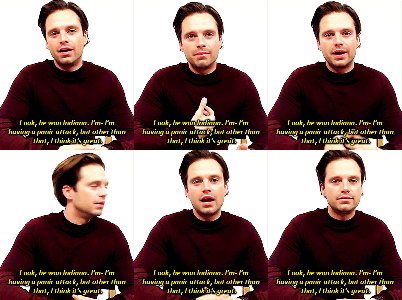
Sebastian Stan was a child in Romania under Ceaușescu’s regime. When you grow up like that, you’re always looking out for the next dictator.
His face in the last gif. It physically pains me, it’s like my feelings about this whole year summed up in one gif.
Shut the fuck up, publicist. Your client has an authentic moment based on his real life, and you want to stop him because it’s off the safe, polished, boring script.
Just for reference, sliced bread was invented in 1928. – (x)
Here’s better perspective for this…
Please notice Bucky took pre-serum Steve to that shit. Just… think about that for a moment.
Remember this post whenever you feel tempted to take the Bucky Barnes Is Overprotective joke seriously. He’s not. That’s probably what made Steve get along with him in first place.
Honestly, Bucky’s complete confidence that Steve wouldn’t drop from a heart attack is funny, alarming and utterly sweet all at once
Just imagine how pretty Bucky had to smile to get out of trouble when he dragged a nauseated, bruised, half-dead Steve back to face the righteous fury of Sarah Rogers…
(And personally, I believe that Bucky is not so much protective, as he is territorial. Steve’s not weak, but lay a hand on him and you’ll learn just how strong they both are)
i think this is my favorite post on this entire site. bless.
WHERE THE FUCK IS THE GIF OF BUCKY THROWING STEVE THROUGH A WINDOW?!
Ok so heres my take: look at his face from the text-less gif on, thats…slightly more upset than anyone should be at a girl noticing your friend and not you.
Shame and self-blaming are incredibly common parts of PTSD, and you can just imagine how Bucky felt getting captured, and after everything he went through (unlike the other Howling Commandos you see all drinking together while hes isolating himself), he’s probably blaming himself for not being smart enough, strong enough, quick enough etc.
And who saves him? His tiny little friend, the one with the huge heart, but the one that always got his ass kicked and needed Bucky to come to his rescue. Now hes this huge super soldier saving him.
I think “im turning into you” doesn’t mean “usually im the hot one and girls dont notice ur skinny ass”, i think it quite literally means, sure, he’s got a big heart, buuut hopefully his big tough bff is around or hes going to get his ass handed to him.
@bloodyneptune I noticed in retrospect that Bucky is not totally okay at any point after Zola first tortured him. Here he is, as you say, drinking by himself in the corner, not with the other guys. He’s not even wearing his uniform tie. I think you’re right that his self confidence was shaken by his experience as a POW. For instance, I think in the train, later they were going after Bucky’s torturer on that mission. He ran out of bullets and he was clearly sick with fear right before Steve tossed him the new gun. I think he was under a lot of strain trying to hold it together in those moments. Bucky saying he had them on the ropes, was trying to reassure himself. Then he falls off the train and wakes up to Dr. Zola standing over him again, and his life becomes a nightmare of continuous physical and mental abuse from then on. Poor Bucky.
Oh man, whats amazing about that (I essayed a whole thing the other day because Im batshit like that) is that Bucky has his own entire storyline going on that you only see through his expressions.
Like, instead of taking up the time to have him talk about it, they just let Seb act it out along side and in the main plot. Like, that small look of total disrepair after “lets hear it for Captain America” which is clearly a victory scene, he’s got his own side story going on. The awesome montage of the Howling Commandos being badass and fun, his little sniper bit? Tucked right between fun, and Steve jovially saluting and back to the kickassery, he looks a lot like the Winter Solder; dead eyed and focusing on the mission, loading another bullet to put in another head.
I mean, you can seen he’s repeating his name and number over and over when Steve finds him, he was clearly already in the process of brainwashing. You’re taught to repeat those things when you’re being interrogated, not experimented on. The best explanation is that he’s trying to keep a hold of his identity. So really, the Bucky we see after he’s rescued is one that already got his toes wet in the Winter Soldier project.
Even when he says he wont follow Captain America, just that ‘little guy from Brooklyn”, I think you can interpret that differently too. The last time he remembers being the big guy, the guy in control, the guy that wasn’t fucked up and was needed to protect someone was with pre-serum Steve. He’ll follow that guy back into the one place he does not want to do because thats whats going to make him feel like he’s tough enough to do it again.
I contend that he held out until they told him Steve ‘died’. He was already going through PTSD, already thinking he was weak and self-blaming for getting himself caught and nearly brainwashed the first time, his last hope had to be “of course Steve will come again, just hold out till then”. If his self confidence and sense of being able to fight was already in pieces, it must have been sort of easy once he knew nobody was actually coming to save him.
A+ analysis It’s interesting that the movie definitely doesn’t spoon feed the story to us. But it’s there all the time. Bucky’s not in First Avenger much and hasn’t got many lines but watching it after WS and CW, wow I saw so much more going on with Sergeant Barnes. I agree that the name, rank and serial number thing showed he repeated it until he put himself into a trance or dissociative state. Then he asked if it hurt when they experimented on Steve to make him a super soldier. Not something I’d think to ask necessarily- does it reflect on the fact that they were already “conditioning” Bucky? Then there’s a great post someone did about Bucky’s and Zola’s expressions when they ran into each other with Red Skull and Cap. I reblogged it a while ago and can find and link you if you want, but the basic idea was Bucky is terrified of Zola and looks right at him, not Red Skull, while Zola stares at Bucky like he’s checking the effects of his experiments, like a scientist looking at a lab specimen. That’s a great example you gave of Bucky’s grim expression when sniping and right after. There’s a wealth of foreshadowing in that first movie and a lot of it is through Sebastian’s acting.
Uggh I know right?? Theres no way they could have fit in scenes of Bucky talking about what he’s going through and keep within the time frame and pacing, really. I think its totally fascinating that instead of just cutting the whole thing, they just let him go through his own plot right along side the main one.
And you don’t really notice unless you’re specifically paying attention to Bucky, because so many of his scenes after he’s captured are within fun, kickass, or silly moments like the Peggy/Steve scene. In the middle of the fun and joking, he’s acting like the mood and tone of the scenes are completely contrary to what’s being presented by everyone elses lines, actions and the way the music and scenes play out.
Actually, I hadn’t considered how oddly out of place “did it hurt” was. I think it would be a question that came long after “what the mother fuck”, “no but what” and “you need to explain this right the hell now because what the everloving shit is happening”.
But duuuude, what they did to him was basically a Hybrid ripoff of the super soldier project, “did it hurt” and “is it permanent” just took on some terrifyingly upsetting alternative meanings. Especially when we know Bucky gets those questions answered.
See what I mean?? They slip in this entirely separate narrative in making it seem like jokes and fun moments, and you almost would miss it if it weren’t for Sebs supernatural acting abilities. It just blows my mind that this shits in Captain America movies.
Have you read about the sounds/music in Winter Soldier? I’ll find it, that shit blew my everloving mind.
(This post is going around. Since I pretty much like the post, I’m making my own post rather than introducing this in the responses there, but I do want to link to it for context.)
A really cool and classy trans lady I corresponded with for a while on a different social site used words like “transsexual” and “transgendered.” She spoke of herself as being born in the wrong body, and she spoke of herself as being biologically male, MTF.
She was in her late 60s.
I did not correct her. I would not in a hundred years have dared.
Given the social climate and hostility she had endured, I was fortunate to be speaking to her at all.
I have occasionally seen younger people criticizing older people quite harshly for that sort of thing. That hurts.
The use of language changes, my friends.
It is so, so very important to help people outside the community understand what language is most appropriate, and it’s important to discuss this stuff within the community so that we can reach some kind of consensus (however messy) moving forward.
It is also very, very important to respect the elders among us, and to understand that their experiences and the wisdom they have to share with us are of tremendous importance and incalculable value. And the language they use? Is part of their history, and our history, and respecting that fact in all its complexity is part of respecting them . . . and respecting ourselves as a community.
Language is so important, but in thirty years I guarantee you some of the language we defend so vigorously now will be woefully outdated, and many of us will still be clinging to it, much to the consternation of the younger generation.
I’m not saying it isn’t important to strive to create the most respectful, helpful language possible, and educate others when it is right to do so. It is vitally necessary that we do so. But we have to remember that this is a process that, thank heavens, never, ever ends.
Language cannot, and should not, stop evolving. Look at us. Look at all of us. So beautiful, so many. We are a dynamic community, a vivid community, full of art and history and passion and pathos and great, great power. Something so lively is always surrounded by change. That is so beautiful, and should be welcomed going forward … and it should be respected looking back.
There are words not yet invented that will apply to those not yet born. Those people should be respected when they join us. And the words we use now, they are good for now, and we should be respected. And our elders should be respected. Letting language take that from us is a horrifying prospect.
So. Let us not forget that language is primarily meant to be what helps bind us together. Let us remember not to let it set us apart, to squeeze us like a fist.
Please remember your history when discussing language. You will eventually be part of our history. You already are. Please. Go with open hands.
Yes. This.
This goes for other marginalized communities as well. I have a teacher who (in his words) “suffers from” depression. I am a strong proponent of the idea that everyone should have the right to define their own existence in their own words. So while I personally favor the neurodiversity model and I much prefer the neutral “has [x condition]” over “suffers from [x condition]”, I am not going to correct my teacher’s language because it’s his choice to define his depression for himself.
Thank you for bringing mental illness into this, because it didn’t occur to me, but there are many parallels, and as I myself am mentally ill and disabled because of it, I feel like I can actually talk about this with some authority.
Speaking as someone with an anxiety disorder and depression-dominant bipolar, I heavily identify with the “suffers from” narrative. Not everyone does. But if I said “I suffer from depression” and someone tried to “correct” my language to be more in line with what genuinely should be the default when you don’t know how the other person relates to their issue, they would get a gentle earful.
When someone tells you how they relate to some part of their core being, you believe them. If they use the “trapped in the wrong body” framework for themselves, respect it, don’t correct it. If they describe themselves as “suffering from X”, respect it, don’t correct it.
Some conditions do not inherently cause much suffering and while some people may indeed be miserable with these conditions, for the most part it’s society’s lack of accommodation that makes those conditions painful to live with. (From my understanding, autism, many forms of physical disability, blindness, Deafness, etc., would all reliably fall into this category.) (This is the social model of disability in a nutshell. The idea that if people were afforded necessary accommodations, these issues wouldn’t be too much of a problem.)
Some conditions absolutely tend to cause inherent suffering simply because that is what they do. What I have is, IMO, one of those things. While I personally know people who have the same exact illness I have and actively enjoy it (mania is apparently enjoyable for a friend of mine), most people who are bipolar, in my experience, do not. That is simply the nature of what bipolar is. Likewise, my anxiety disorder: if it did not cause suffering, it would not exist. That’s what it is. It causes discomfort, sometimes so acute I cry or feel like I’m going to throw up. You can’t accommodate me out of it, though you can damn sure make it worse by not allowing me to take care of it.
It’s a fact that if we accommodated these things better, the suffering would be less. For instance, if I were afforded enough money to live on each month, adequate medical care by competent professionals willing to treat me as the authority in my illness, and appropriate medication, I would be a lot happier. I do not have those things. I am absolutely made more miserable because of it. But no level of accommodation will stop my neurotransmitters – or lack thereof – from making me miserable from time to time.
The language that it is appropriate to apply to someone else may very well differ from what they use to describe themselves. There are some things it is not okay to impose on other people, even as it is perfectly okay to be those things.
Language develops and grows, and we are always seeking good terms to use that describe people without assigning them characteristics or narratives with which they may not identify. That’s a good thing. I get very frustrated when I see people complain about changing language, or “made-up terms”. That attitude is an active resistance to positive change.
I also get very frustrated when I see people trying to stamp out words without knowing their history, or respecting people who use those word, and have used them for decades (e.g.: “queer”, which you will pry from my cold dead fingers).
We need a better understanding of the necessary divide between personal experience and group descriptors.
This is a big thing in the autistic community. Older folks (I’m talking the >35 set by and large) lean more towards person-first language. Younger folks (like me I admit) lean more towards identity-first.
And there’s a good reason for that in both cases. Folks who grew up in the 70s and earlier were around for the early disability rights movements – they remember the time when identity-first was used to dehumanize and other. Person-first is their way of fighting back: I am a person, you will not forget that.
Younger folks were around for Autism Speaks and its co-opting of person-first language for its own bigoted ends. For the era of forced normalization, of passing, of “I Am Autism” and “Autism Every Day,” of being portrayed as demon-children while your abusers and the killers of people like you get fawning attention because it’s ever-so-difficult to be around people like you, and of personhood and autism being considered mutually exclusive and personhood being conditional on passing – so if you pass, you’re not autistic and don’t have a right to an opinion because you’re not severe enough, and if you don’t pass, you’re too severely affected to really understand how wretched you are, and therefore you don’t have the right to an opinion. For us, identity-first is a way of claiming our voice – it’s an extension of nothing about us without us. I am autistic, and I am a person, and you don’t get to choose which of those you respect. You will listen to me, because of both, not in spite of one.
What I’m pointing out here is that sometimes generations can have mutually-exclusive language preferences for what amounts to the same underlying reason, owing to differences in culture at the time of the generation’s coming-of-age. Person-first and identity-first are in fact mutually exclusive – someone cannot simultaneously respect my wish to be called autistic and another person’s wish to not hear autistic people referred to as autistic. But they’re both rooted in a demand for respect, a demand to be recognized as a full person.
The autistic community has mostly settled this issue by saying you have the final call in how you are referred to, but you don’t have the right to push others into identifying differently. The wishes that get respected in an instance are the wishes of the person being referred to. So you would refer to me as autistic, and you might refer to someone else as a person with autism, and both are okay as long as you’re respecting the identity of the person in question.
I think the QUILTBAG community could really benefit from taking that sort of attitude, too. Case in point: For me, I would never refer to myself as dyke and would get really fucking angry with anyone who did refer to me as dyke- I lived in a very old-fashioned community. Dyke was a tool of dehumanization and a threat. I hear someone call me a dyke and I’m 8 on the playground having my face smashed open on a chunk of ice to the tune of “Dyke bitch! Dyke bitch!” again. No amount of reclamation is going to lessen that association for me. But other people want to reclaim it as a sense of defiance – I’m a dyke, what of it? I respect their defiance, and I respect their right to choose the language with which they identify.
This is such a cool addition to my post. Thank you.
also i will keep saying this until i die because correcting people’s language is the first taste of power a lot of young kids get, and they go fucking nuts with it. but policing people’s language and demonizing them for using the wrong words or phrasing things in clumsy way isn’t just shitty activism, it’s anti-activism.
jumping on people for which words they use to talk about issues, instead of engaging with the content and intentions of their speech, it paralyzes people, it scares them. knowing that one verbal misstep will get you called transphobic— even if you’re trans, even if you’re trying to talk about your own experiences— shames and punishes people for innocent actions, for insults they never meant. this isn’t activism. this makes people passive. i have seen over and over language policers send this message: do what i say, say what i say, or be punished.
language policing inevitably warps all discourse away from focusing on real-world action into the most petty, pointless, divisive bickering over individual terms and phrases. like, is it lgbt or mogai? who gives a shit. if you think the title of a community is more important than respecting and connecting with the people in it then you’ve already failed. is it transsexual or transgendered? if you attack trans people for calling themselves what they like, you’ve fucked up.
Well, the problem begins (as problems often do) with comics.
See, comics are a sort of ‘soap opera with capes and tights.’ Comics are ‘fanfic but written by mostly straight white guys who are chosen by other straight white guys.’ Comics are a never ending arms race of suffering, and that’s the problem.
So it’s hard to pin down a character. Because it’s not one character.
Every writer wants to make their mark. They want THEIR version of the character to be the one that people point to and say, “THIS. THIS is the quintessential Hawkeye. THIS is the reason I love Hawkeye.”
Because they’re not going to write the character forever. That’s comics. There’s always someone right behind them, nipping at their heels, someone who wants nothing more, in most cases, then to sweep their careful work aside and make THEIR mark on the character.
There’s not much you can do to stop that from happening. You can write a really good book, you can be clever and creative and still not hit the readership the right way. You can write A GOOD BOOK and you’ll still end up in the trash heap of the 25 cent bin, because the promotion team or the movie schedule or the competitor’s event cycle screwed you over.
It’s much easier to make a lot of noise. To be remembered, rather than beloved. To get people tweeting and talking and protesting and fighting, because that means when you tossed off this book, there’ll be another one waiting for you.
Don’t believe me? I mean, someone keeps giving Nick Spencer new books. (shrug)
So there is no one Hawkeye. The Hawkeye of the early West Coast Avengers has little in common with the Hawkeye of Fraction and Aja’s solo book run. The Hawkeye of the most recent Secret Avengers by Ales Kot would be unrecognizable to the Hawkeye of the Ultimates verse. Movieverse Hawkeye is almost a mirror image of Hawkeye of Avengers: Earth’s Mightiest Heroes.
When you love a character, the question is, which one? Because even if you take fandom interpretation and fanon out of the equation, there’s a lot of them to choose from. And while canon feeds fanon, fanon bleeds back into canon.
Describing the character you love takes some effort, some cherrypicking.
For me, it’s this:
On the surface, he’s ordinary. And his awareness of his ordinariness is part of what makes him so extraordinary. He’s raised himself to his current position by sheer force of will and a refusal to stop. He’s bullheaded and snarky and has a chip on his shoulder the size of the island of Manhattan. He’s not as stupid as he thinks he is, and he’s not as good as he believes he is, and both of those facts are a little heartbreaking.
He’s a man who destroyed his own hearing, because he knew if he didn’t, he was going to hurt someone he loved. He’s also a man who entered canon trying to rob Tony Stark, which was universally regarded as a very bad idea, since that’s how a lot of people end up dead.
He’s not a god or a genius or a super soldier.
He is a man who looked at the end of the world, and said, fuck you, I’ve got a COUPLE OF STICKS AND A PIECE OF STRING and I’m still going to KICK YOUR ASS. There is something comforting about that, for most people.
We want to believe, after all, that if push came to shove, if things got bad, then we would stand up. With all the risk, and all the fear, and a very good chance that we would not win, we want to believe, that we would still stand.
So all the other stuff, the ragged ends and the bad choices, the stupid plots and the OOC moments, the embarrassing contradictions in canon and the writers who can’t figure him out or don’t want to bother trying, it melts down to one truth at the core of his character, every time.
He is a man that doesn’t feel too different from you or me. And he stands. He makes bad choices, he screws people over, he ruins relationships and cheats on partners and girlfriends, he does stupid, stupid things, because this is a soap opera, and half the writers don’t remember what the last one did and the other half don’t care.
For all the parts of him I don’t like, he’s still my favorite. Because he shouldn’t be there. He has no place there. He’s outgunned and outflanked. Everyone around him is smarter than him, better trained than him, better equipped than him.








































 Tumblr Exodus