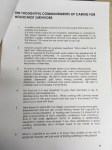
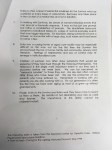
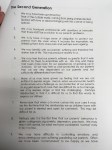
As some of you may or may not know I work in a Jewish hospital that provides rehabilitation and palliative care, and we were provided w this booklet regarding care for holocaust survivors and family members
I thought I might share it since it may be of use to other ppl who care for older Jewish people
Tbh some of this, in particular the first few bullet points, looks broadly useful for talking about trauma and generational trauma even outside the specific context of the Holocaust, and this deserves to be shared around! Thanks for putting it here.
text transcript:
Ten Thoughtful Commandments of Caring for Holocaust Survivors
This is a really useful set of points for not only what it’s explicitly created for (which is in and of itself very important), but yes, also for a *lot* of major trauma, intergenerational trauma and its effects, and also useful to read through and just think about how these things apply to trauma and intergenerational trauma generally (which I promise is actually all around you, wherever you are, and affecting things in ways that one doesn’t notice, really, until one does.) Thank you in particular @kaaramel for the transcript.
What is meditation basically? Lots of people will tell you that meditation is supposed to calm your mind.
But what will really meditation do to you is that you’ll be able to CONTROL your mind. Or at least you’ll be better at it, which is something huge, believe me. And controlled mind is a big tool in magic work.
There are 3 basic types of meditation.
1. Just observe your mind. This is something that you can do when you have time. Sit on your couch, lie on your bed – whatever feels good for you – that’s the key. Close your eyes and just try to observe what’s your mind up to. The important thing is – don’t try to think. Just let your mind exist. It almost feels like falling asleep, actually. Once you try it you can feel how freeing that moment is.
2. Be aware. Yes, awareness of your body and later, of what is happening around you. For example, try to be aware of your breathing. Focus on how you breathe. Just feel how your nostrils feel the air coming in and out. Tap on your forehead with your finger and feel the spot. Be aware of the sensation. Focus on it like nothing else exist. Just the sensation you feel on your skin.
3. Focus on one thing and one thing only with your mind. As I always say, start with something easy like an orange. Orange is easy to imagine in your mind. Picture its structure. Picture its taste on your tongue. Picture how it feels when you touch it. Basically, put together a picture of everything you know about the orange and keep mind picturing it. Feel the orange for as long as possible. If you lose your concentration, it’s alright and you did nothing wrong – we’re humans, not robots. Just try again 🙂
Questions you may ask:
Q: What if I don’t have time for meditation? I’m busy with school and work!
A: Well, of course we live in a world that needs our presence. And number 2 and 3 can be done while you wait for the bus, while you’re stuck in traffic jam, and so on. Don’t lose hope, just because you’re busy 🙂

Q: Is it really necessary to meditate?
A: Nothing is necessary, it’s your choice. But the truth is, if you choose to meditate, you’ll be able to control your mind better and it’s not only helpful in magic work. It can help you if you have trouble sleeping and so on. Helps with anxiety, too, btw.
Q: How does meditation help control mind?
A: Number 1 can teach you:
– how to be aware of what’s going on in your mind on the level you can’t reach yet. Later, you can use this new entry to your mind and analyze your psyche better.
– how to not fall asleep when you try astral traveling before going to bed.
– lucid dreaming 🙂

Number 2 can teach you:
– how to be aware of what your body wants and needs even though it can’t speak.
– how to be aware of what is happening around you in a crowd – kind of good skill to have these days, sadly.
– how to feel if something paranormal is happening around you.
Number 3 can teach you:
– how to use your willpower as a tool for your magic work.
– power of good imagination raises IQ and plain common sense.
Remember that if something isn’t going well for the first time you try, it doesn’t mean it’ll be like this forever. Things can better with practice. So don’t worry. We were all lame shits when we started.
Widely hailed as the Beyoncé of Japan, Naomi Watanabe does spot-on impressions of Queen Bey down to every last stiletto stomp, sashay, and hair flip. And when it comes to makeup, the actress and comedian demonstrates the same dexterity.
Taken from Adult Children of Emotionally Immature Parents by Lindsay C. Gibson, Psy.D. A summary of the tips the book hands you on how to recognize emotionally healthy people.
They’re realistic and reliable
They work with reality rather than fighting it. They see problems and try to fix them, instead of overreacting with a fixation on how things should be.
They can feel and think at the same time. The ability to think even when upset makes an emotionally mature person someone you can reason with. They don’t lose their ability to see another perspective just because they aren’t getting what they want.
Their consistency makes them reliable. Because they have an integrated sense of self, they usually won’t surprise you with unexpected inconsistencies.
They don’t take everything personally. They can laugh at themselves and their foibles. They’re realistic enough to not feel unloved just because you made a mistake.
They’re respectful and reciprocal
They respect your boundaries. They’re looking for connection and closeness, not intrusion, control or enmeshment. They respect your individuality and that others have the final say on what their motivations are. They may tell you how they feel about what you did, but they don’t pretend to know you better than you know yourself.
They give back. They don’t like taking advantage of people, nor do they like the feeling of being used.
They are flexible and compromise well. Because collaborative, mature people don’t have an agenda to win at all costs, you won’t feel like you’re being taken advantage of. Compromise doesn’t mean mutual sacrifice; it means a mutual balancing of desires. They care about how you feel and don’t want to leave you feeling unsatisfied.
They’re even-tempered. They don’t sulk or pout for long periods of time or make you walk on eggshells.
When angered, they will usually tell you what’s wrong and ask you to do things differently. They’re willing to take the initiative to bring conflict to a close.
They are willing to be influenced. They don’t feel threatened when other people see things differently, nor are they afraid of seeming weak if they don’t know something. They may not agree, but they’ll try to understand your point of view.
They’re truthful. They understand why you’re upset if they lie or give you a false impression.
They apologize and make amends. They want to be responsible for their own behavior and are willing to apologize when needed.
They’re responsive
Their empathy makes you feel safe. Along with self-awareness, empathy is the soul of emotional intelligence.
They make you feel seen and understood. Their behavior reflects their desire to really get to know you, rather than looking for you to mirror them. They aren’t afraid of your emotions and don’t tell you that you should be feeling some other way.
They like to comfort and be comforted. They are sympathetic and know how crucial friendly support can be.
They reflect on their actions and try to change. They clearly understand how people affect each other emotionally. They take you seriously if you tell them about a behavior of theirs that makes you uncomfortable. They’ll remain aware of the issue and demonstrate follow-through in their attempts to change.
They can laugh and be playful. Laughter is a form of egalitarian play between people and reflects an ability to relinquish control and follow someone else’s lead.
They’re enjoyable to be around. They aren’t always happy, but for the most part they seem able to generate their own good feelings and enjoy life.
Hey followers! Can you reblog this? I want it to reach as many Jews as possible. If you could reblog this even if you’re not Jewish I’d appreciate that too, because you probably have followers who are. Also, non-Jews are totally welcome to watch the livestreams too, if you want! Thanks 💙
@vaspider I figure you or some of your followers might appreciate this, considering I’m sure not everyone who wants to go to services can.