Ah, the main character. If your story were a ship, they’d be the pilot. It’s their job to incite, propel, and solve the plot, all while making the readers laugh and smile and cry and get frustrated, and oftentimes they carry with them the moral lesson. This is a pretty tall order for one character, and deciding what kind of main character you’re going to have can be very stressful. Hopefully this list will help you with this process.
The main character can determine the audience.
This isn’t always true, but usually the age, gender, moral compass, and sometimes even physical appearance of the main character decides what kind of people are going to read the book. A book about a 14-year-old female fashionista usually attracts different readers than a 50-year-old FBI director. Don’t let this scare you, because there are outliers depending on how the character is written, but bear in mind that people of like-minded interests usually read books with main characters that share some of those traits, so plan accordingly.
The main character’s personality traits should coincide with the plot and theme of the novel.
High-fantasy and adventure novels are usually headed by strong-willed, talented, reckless characters. (Think Luke Skywalker or the Winchesters from Supernatural.) Realistic fiction, however, are usually home to goofier, more human characters (such as Greg and Earl in Me and Earl and the Dying Girl). While your main character doesn’t have to be the cookie-cutter model of the “normal” protagonist for genre and theme, they should exhibit at least some of the traits. Give some of the entertaining, off-color traits to supporting characters if you can’t live without them.
Make them human.
Real people are complicated. Their emotions and actions are driven by complex, sometimes misguided desires. Real people make mistakes for much the same reason. Real people doubt themselves, and they have low and high points. Real people change over time based on the people and circumstances they surround themselves with. Real people sometimes lie to others and themselves about their true motivations. Real people need help and support from others to reach their goals. Sometimes, real people never reach their goals at all. Characters should reflect all of this in their stories, especially main characters, with whom your readers should identify with and root for the most.
Make them likable.
This doesn’t mean they have to be perfect by any means, nor do they have to be friendly and sweet 100% of the time. Your main character can actually be a total asshole but still have readers like them or be entertained by them. The main thing is that you have to make sure that the reader roots for them, because if the reader is hoping the main character will fail or loses interest in them completely, you haven’t done your job as a writer. Beta readers can help you by telling you whether or not they like the main character and agree with their actions.
Make them fit their story.
Characters are TOOLS, just like every other story element. They are there to ad to the reader’s experience, and whatever triumph or turmoil they go through is so that the reader can be entertained and enlightened by their story. That’s why it’s important for them to be treated as such, and NOT like friends or ways for the author to live vicariously through their own story. We have fanfiction for that. When you’re writing, if it seems like your story is revolving around amking your main character happy, or that they’re becoming just too perfect to be entertaining, you may need to step back and re-evaluate their score on the Mary Sue litmus test and see if you’re writing a character or a mannequin doll.
My personal favorite character template sheet, written by Dehydromon on Deviantart. It’s the first link on FYCD’s post and has 370+ questions to answer about your character. (For a shorter version, go here.)
Writerswrite’s how-to-create-a-character guide. (It’s basically another template, but I thought I’d include it in case someone didn’t like the others I provided, and also because it comes from a more professional source than Deviantart and Tumblr.)
Wikihow’s tips on creating a fictional character from scratch. Their tips are very broad, but they leave a lot of room for interpretation as well, if you prefer that.
Thecreativepenn’s 5 tips for creating interesting characters. This article seems to be geared towards screenwriters, but the tips apply to all forms of creative writing.
It’s rather chilling to consider that one of the most indelible images in the Star Wars saga is its heroine silenced, stripped down, and in chains. I know a lot of men have positive feelings about this particular costume — in fact there’s an entire episode of the popular sitcom Friends that’s devoted to it — which is why it’s kind of hilariously ironic that Han Solo was blind during these scenes. That is, the one man who is romantically attached to Leia is the one man who never saw her in the golden bikini. Which means Han Solo is more attracted to a mouthy space age shield maiden than he is to a tight female body on display. In fact, if I could be so bold, I would suggest that Han Solo would be more turned on hearing about how Leia strangled Jabba the Hutt to death — using nothing but the chain that enslaved her — than he would be hearing about how his sworn enemy turned the woman he loved into a tawdry plaything.
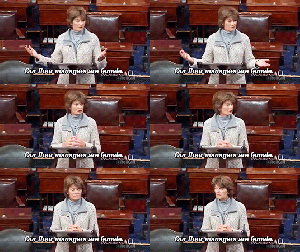
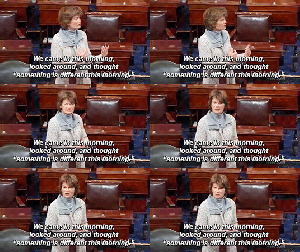
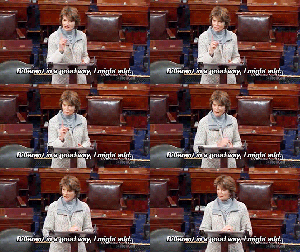
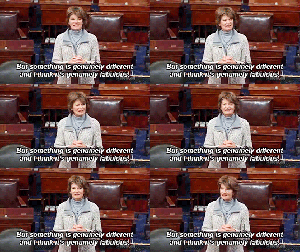
“So perhaps it just speaks to the heartiness of women, that put on
your boots and put your hat on and get out, slog through the mess that
is out there.” – Senator Lisa Murkowski (R – AK)
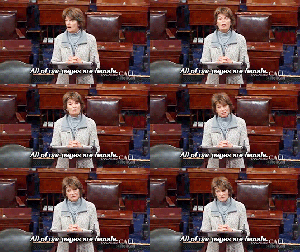
On January 26, 2016, two days after a large blizzard in DC, something was different in the US Senate. No men showed up. For the first time ever, the entire present Senate staff was female. (video)
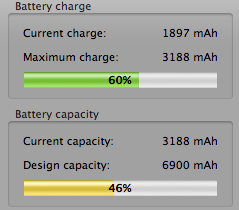
another person on facebook was having trouble getting their family to understand the spoon theory because they couldn’t wrap their head around the metaphor so I wrote up a detailed version of my battery post I made ages ago inspired by my macbook, might as well post it here too.
I’ve never been a big fan of the spoon theory because it’s kind of
abstract and confusing to explain unless you print out and carry the
thing with you and make people read it because it makes NO SENSE out of
context so I made one that most people will be able to understand
easier. (might not help with elderly people but generally they will get
it because their battery might not be defective, but all batteries stop
holding charge when they get old so they are more likely to Get It without a metaphor)
When you get an electronic device, like a laptop or cell phone it comes
with an rechargeable battery. Some people are unlucky and get a dud. Or
maybe there is a recall and the entire line of the product due to a defect.
My battery isn’t any good.
When I’m all charged up I and it says it’s ok to unplug the charger,
I’m not at 100%. I haven’t been able to charge that far up for years. I
am already basically in the yellow when I start my day. If you only have
a half hour of battery life just browsing the internet, how are you
expected to load a flash video to watch that takes up way more juice?
You can maybe do it with the right help, such as a portable charger
(here representing accessibility devices like wheelchairs, or treatment/medication). Sometimes the percentage amount is also inaccurate
to. It says you have 20% battery and 20 minutes left and then your
computer just -shuts off- out of nowhere. Surprise! you crashed! I hope
you were anticipating that risk and saved your work!
In addition
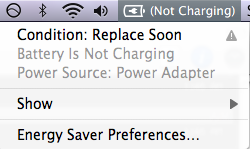
my charger doesn’t always work.
I can plug it in and it just says “not
charging”. So sometimes you leave the computer overnight to charge and
wake up, wait, 30% battery when my 100% is a normal person’s
60%????!!!?? not fair! This is what happens when you combine in the
restfulness or inadequate sleep.
The combination means you are
really working at rationing what you can do with your device. Should I
turn it off most of the day in case I need it later? How many people can
I talk to on my phone for how long before it runs out of juice. How
much work can I get done on my laptop before the battery dies, possibly
taking the work with it?
That’s how are bodies are. We have to
carefully monitor how much energy we (think) we have, what amount of
stuff we should be able to do with it, what must be sacrificed, as well
as try and keep track of charging stations, battery packs etc. to rescue
us if we miscalculate. And if we do we could lose something important
in the power outage.
But batteries aren’t user replaceable and
we don’t have a warranty, we can’t get it fixed, just have to deal with
it as well as we can. The battery does not define us but it effects every part of our lives effecting everything we do and every decision because while most people haven’t experienced a energy crash, they have probably experienced the hell that is the computer shutting down and destroying hours of effort you’ve put into something as punishment for taking that risk.
I have been in publishing for over ten years, mostly as an editor. I am the person who accepts or rejects your manuscript. Here is how I make my decisions.
I look at the envelopes I am opening as I work my way down the slush pile. Sloppy presentation is not a good sign. Neat, clearly labeled parcels give me hope. I haven’t even seen what’s inside, and already I’m making judgements.
Out come the manuscripts. I check each one for a self-addressed return envelope with sufficient postage attached or with enough international postal reply coupons (if it comes from overseas). Is the SASE big enough to hold the whole MS? Or is there a letter-size SASE for my reply? Good in both cases. I keep this submission on my desk. No SASE? I put the MS to one side. Maybe I’ll read it. Probably I won’t. I’ve had writers who’ve said: ‘You won’t find an SASE here because you won’t be rejecting this novel.’ Yes, I will. He just won’t be seeing his MS again, because I won’t be paying to mail it back. I also say goodbye to submissions without return addresses and submissions from overseas with their local postage attached. If the writer makes it too difficult or costly for me to contact him, believe me, I won’t. Why would I give him more consideration than he has given me, an overworked editor? He’s not that special. I am not that into him.
The submissions with proper SASEs are sorted again. Most rejections happen right then. Why do I reject them?
I’m not a conspiracy theorist. For a variety of reasons I’m not about to get into in this particular forum, I don’t believe the U.S. government was responsible for 9/11, but I do believe, when given a window of opportunity, our government takes advantage. I think, given the last 15 years, history bears that out.
Maddow, in a very readable and approachable way, documents the way in which this has happened and is happening in our military and foreign policy. She starts with Reagan, who was the first to really work in earnest to erode the separation of powers so very clearly written into the U.S. Constitution and prop up the Executive Branch as war-maker in chief. Lest you think her criticism is partisan, she makes clear that every president since, more or less, has either kept the status quo or sought to gain new authority for the Office of the President.
It’s terrifying.
(Also, as an aside, Trump’s candidacy is less unbelievable when considered in the context of Reagan’s path to the presidency. The Gipper also just liked to make shit up.)
There are others who have written on this topic in greater detail, from the military or judicial or political perspective, but this is by far the most accessible discussion of what’s really at risk when we wage wars that occur outside the public eye, or, rather, without any of the public investment our founding fathers deemed necessary if our country was going to spend tax dollars and lives “defending our borders.”
I don’t think Bernie Sanders is going to turn around America. I think the vast majority of his policies, even if he should somehow manage to win both the primary and the general (unlikely) don’t stand a chance in Hell of making it through Congress. But of all the candidates, he’s the only one I can see turning the tide on this one and rescinding some of the powers stolen from Congress by the presidents before him. Honestly, that’s reason enough for me.
But this book isn’t about Bernie Sanders, or about politics, partisan or otherwise. It’s about a bloated Defense Department, a greedy Executive Branch, and an American public that’s content to look the other way. I think you should read it.













 Tumblr Exodus