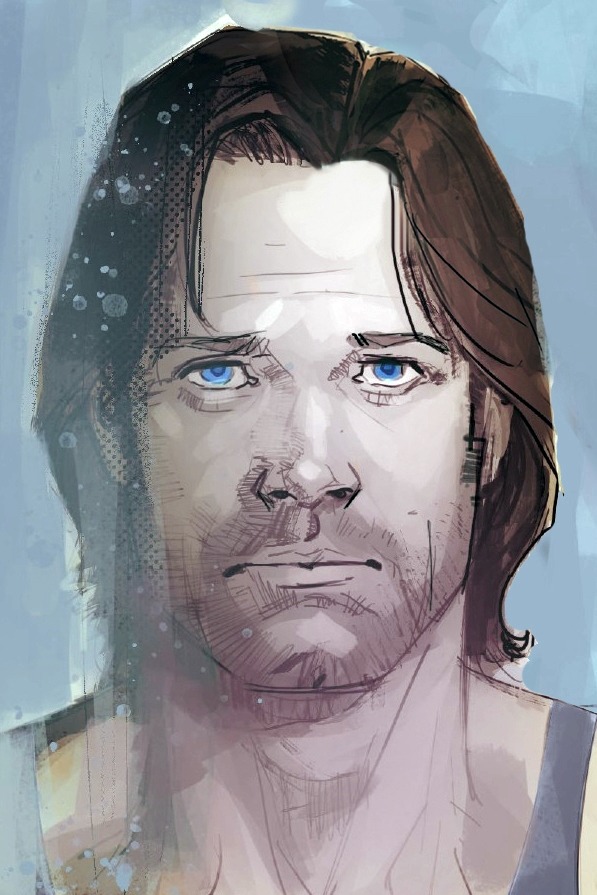
“There’s a memory… I’ve been on the edges of…”
Winter Soldier #1 (2018)
I was talking to @walburgablack this morning on Instagram of all places (we are all desperate not to lose one another, and some of us jaded veterans long ago started exchanging our other handles, because we have never believed any one site would stay), and while both of us are the sort of inveterate essayists who have no real problem fitting in to a largely text-and-OP-based platform like Dreamwidth, we were mourning a little about what we’ll lose by leaving Tumblr.
She pointed out that it’s not that you can’t lurk on DW; it’s dead easy to just read and not post. But she admitted, it’s a big barrier to actually follow someone instead of reading silently on their page, and an even bigger barrier to actually leave a comment– you have to be coherent, you know?– and like her, I admitted I was using the current kerfuffle as a good reason to actually follow people I’ve definitely read for a while but never actually engaged with in any way. (I am absolutely feeling weird about the social-order inversion of following handles to other sites when they are relative to me very BNF and I’ve never actually spoken to them before but here I am with them suddenly following me back when we were never mutuals on Tumblr? It’s weird. I feel like I’m presuming.)
I was on Livejournal for about a decade before it imploded (I never left, I just also never accepted the latest TOS that wasn’t translated into English, so my crossposter broke and it kicks me back an error a day)– and in that time, I know I had a substantial following of anons who never commented, never reached out to me, never contacted me, but once in a great while someone would leave an anon comment or, later, on another platform, would confess that they’d been reading me for years. Now, I was not a big f-locker on LJ, so there was a ton of stuff I wrote publicly about. (Towards the end, I started having some hostile RL anons– I never did find out who, but someone who knew me was reading my blog and copy-pasting it for non-readers. Even f-locked posts sometimes, so I had to lock down a lot of things. This is preserved in my privacy groups on DW, even though I don’t really remember the details otherwise– some of those groups are explicitly me trying to exclude the person whose account i thought was being used to read locked posts and copy-paste them to stir shit. I never did figure it out, and anyway– LJ imploded, and the RL drama changed, and nobody cared anymore, but. This involved MySpace too, for the record, so there’s some ancient shit for you.)
And what I’ll miss about Tumblr is that it lowered the bar for engagement. I have a lot of followers on Tumblr, more than I ever had on LJ. And an awful lot of you don’t write a great deal on your own. You like posts, and you reblog stuff, and sometimes you leave replies, which usually make my day. But a lot of you have moved into being people I recognize, people I care about, people whose rare actual commentary is a thing I treasure. And that built up because I can form a mental relationship with an avatar and a series of “likes” and reblogs; I can tell what you’re interested in of my content, if it’s that you came for the fic and stayed for the cute farm pictures, or vice versa. It’s all very pleasant. Even if it’s just that you’re only into the fic and don’t care about the rest– that’s cool too! I appreciate that, and it’s part of my experience here.
And you-all are the ones I’m worried for, now. On DW, what will you do? Is there room for you? Of course I think so, I can’t help but write thousand-word essays every time I sneeze. I’m a content creator and it’s what I do and I couldn’t stop if I tried, and I have been chafing in dissatisfaction (i.e. I’ve fucking hated it) for six years on this site because it’s not really designed for me, and I’m fucking delighted to be hopefully finding enough people on a better text-based platform for it to meet my social media needs.
But, as someone said over there, it’s kind of like everyone’s coming home from war. Like… home, what a profound relief, but… we’ve lost so many and it’s been hard and some of us are pretty fucking damaged, and it’s never going to be the same.
And the casualties are going to be the people who don’t fit on text-based platforms. All of you darlings who don’t have a lot to say on your own, but love things, and curate their reblogs, and signal boost what they believe in, and like what they like and comment only rarely and with great trepidation but often with fantastic insight–
Oh, I’m just so worried for all of you. I don’t know if Pillowfort will work for you better; I’m going to look over there, worried as I am about their weird UI blind spots and their shaky underpinnings and good-natured (?) ignorance about real-world problems and why can’t i see who liked my posts why have likes– if I can get the site to load, it spun a little wheel for me for two hours last night, I haven’t logged in since mid-November– and I’ll be on Twitter and Instagram and all of that shit.
But I’m just worried. I don’t want to lose you. I didn’t really mind my LJ anons? but I couldn’t have much of a relationship with them, because I couldn’t see them, I couldn’t know who they were. And they were scary sometimes. Some of them were definitely hostile. I kept having to turn anon commenting on and off. I’ll try to turn it back on, on DW. It lets you use OpenID if you’re not willing to log in, which is a super 2005 kind of dealie, but it makes sense, I promise. I literally don’t remember how it works but it’s a thing.
(There are still hostile anons on Tumblr too! Just, the barrier for engagement is slightly higher for them, there’s no “dislike” button, and silently hatereading is as invisible as it was on LJ.)
I don’t want to go back to that. I want there to be room for everybody. I’m hoping DW brings back more nuanced discussions, sure, and Tumblr’s a hellsite I can’t wait to escape, sure. But.
I’ll miss you. I hope you find a home. And I hope that home still includes me somehow.
[me: dreamwidth | instagram | pillowfort | twitter | ao3]
All of this and to also say that lurkers are absolutely welcome on dw. A single post on your dw that you read but don’t post (just so folks know it’s not an empty journal later).
A long passage from Sarah Schulman’s The Gentrification of the Mind: Witness to a Lost Imagination, concerning the anti-sexuality current in the mainstreaming of queer literature, and in particular a detailed account of the 1994 censorship case surrounding the Canadian Little Sisters bookstore.
I think it’s valuable not just for its description of the double-bind queer folks are put in when we’re asked to sanitize or disavow our own sexual realities in order to gain mainstream acceptance, but also for its glimpse into the mechanics of what exactly the process of implementing censorship criteria looks like—who has the power, who gets silenced, and how that can intersect with systems of oppression. All bolding mine.
The truth—that queer, sexually truthful literature is seen as pornographic, and is systematically kept out of the hands of most Americans, gay and straight—has been replaced with a false story of a nonexistent integration and a fantasized equality. […] In my own experience, the [mainstream] equation of queer literature with pornography is undeniable. […] Of course, in gay time, “recent” quickly disappears because so many participants are dead, and others have been silenced. It’s hard to have collective memory when so many who were “there” are not “here” to say what happened. Once the recent past is remembered, then the Amazon “glitch” [in which LGBT titles were automatically removed from Amazon’s listings during a porn purge in 2008] becomes all too consistent. So, here is just one example, exhumed from memory.
In 1994, a coalition of feminists and right-wing politicians in Canada passed a tariff code called Butler that was designed to restrict pornographic production. Instead, it was applied in such a way that it allowed officials at Canada customs to systematically detain and destroy gay and lesbian materials at the border. A gay bookstore in Vancouver, Little Sisters, had so much of its product seized that it could no longer operate. As a result, Little Sisters decided to sue the Canadian government.
My friend John Preston had just died of AIDS. He was the author of some iconic leather and S/M novels, many with literary bent. His novel Mister Benson had been serialized in Drummer magazine, and created a subcultural phenomena. Men would wear T-shirts asking Mister Benson? Or asserting Mister Benson! While he had a less explicit series called Franny, the Queen of Provincetown, John was perhaps best known for his book I Once Had a Master. Since he was newly dead, I was asked by the Little Sisters legal team to come to Vancouver and testify on John’s behalf. And because I was very clear in my opposition to state repression of gay materials, I had no problem agreeing.
The Canadian courthouse was quite shocking to this New Yorker. No metal detectors, no armed guards at rapt attention in every corner. The building looked like a Marriott hotel, with lovely plants, comfortable seating, and a coffee bar. But do not be fooled, the Canadian government proved to be a vicious animal with a demure exterior.
Tensions were high in the courtroom the day I arrived. The trial had been going on for weeks and many writers had testified. Patrick Califia, who at the time had presented as female with the name Pat, had been on the witness stand the Friday before and had done so well that the Crown had refused to cross-examine him. Interestingly, “Pat”—who was known as a butch leather dyke—had taken the extreme step of wearing a brown corduroy dress, which impressed me. We were, after all, trying to win. I, and I assume many of the women testifying, had agonized over what to wear on the stand. The only nice dress I owned in 1994 was black velvet—kind of a parody of a dress, and something to be worn to the opera. Anyway, I wore pants. Becky Ross, a Canadian academic, testified before me. She wore a dress, but I think she always wore a dress. Anyway, the Crown had been pretty hard on her, asking her to define “fisting.”
John’s books were being persecuted on five counts. The questions I had to address were: Is it violent? Is it degrading? Is it dehumanizing? Does hit have literary merit? Is it socially redeeming? If I had had my way, I would have argued that even if the books were violent, degrading, et cetera, they still should be available. However, Canadian courts had already ruled on that question, so my only remaining strategy for protecting his books was to “prove” that Butler should not be applied to him. Not that the law was wrong.
So many years later, this is the conundrum gay writers faced with the Amazon exclusion. Mark Doty, Larry Kramer, and many other principled gay writers noted online and in print that books like Giovanni’s Room and Oranges Are Not the Only Fruit were being falsely labeled as pornography. Once again we were forced by a state or corporate apparatus to claim that our literature was different from that dirty stuff, instead of part and parcel with it. But it is the homosexuality that got the books marginalized in the first place. Not their sentence structure.
[…]
The actual testifying did not go that well. Once I got on the witness stand, the Crown claimed that I was not qualified to be an expert on “harm.” I said that as someone who has experienced “harm” for being a lesbian, and especially for being a lesbian writer, I was quite expert on the matter. I argued that “homophobia is a social pathology that causes violence and destroys families.” I said that gay and lesbian books are a mitigating force against homophobia and therefore are socially beneficial and the opposite of “harm.” The Crown claimed that I was not qualified to make this statement because I am not a sociologist. They won, and I was forbidden from addressing that issue in court.
This was the first indication I had of our judge’s conceptual limits. As we moved along, I came to learn that Milord did not know what “deconstruction” meant. And later he revealed a puzzlement over the meaning of the word “enema.” Oh no, I thought. If he has never heard of enemas or deconstruction, we are doomed.
The Crown read out loud a passage from one of John’s books describing nipple torture. It was a bit surreal. Then he asked me if this was “degrading or dehumanizing.” I did my best.
Through the rest of the trial the government repeatedly made clear their view about any gay sex. They had seized a lesbian anthology called Bushfire because it included the line “she held me tightly like a rope,” which they said was “bondage.” They had also seized a book called Stroke, which was about boating.
In the end, after many more years and courts and dollars, Little Sister lost their case. The judge ruled that Canada customs officials had, and still have, the right to decide which materials are not suitable to come into the country. Interestingly, they quickly ratified gay marriage, while continuing to retain the right to insure that no married gay man will ever go looking for Mister Benson.
Those two days in court made it crystal clear to me that in the minds of many people, homosexuality is inherently pornographic. And there is nothing that has occurred in the subsequent three presidential terms that has created any other kind of context. The best proof is in our contemporary placement and treatment of sexually truthful gay literature. That John Preston was invited to give a keynote address at Outwrite, the now defunct lesbian and gay writer’s conference, was a sign of the prominent and central role of sexually explicit content in gay literature when it was controlled by the community. Now that gay presses and bookstores have been gentrified out of existence, first by chain stores like Barnes and Nobles, which are now being outsold by Amazon.com, gay literature is at the mercy of the mainstream. […] This puts gentrified queer people in a terrible bind: we can dissociate ourselves from the full continuum of queer literature, that is, from queer sexuality, thereby falsely describing our literature as “quality” if its sexual content is acceptable to straights. But that is a kind of implicit agreement that we only become deserving of rights when presenting as somewhere between furtive and monogamous.



As Advent draweth nigh, I recommend to you:
Naxos Musical Advent Calendars 1 & 2 (Android OS)
A new day, a new piece of classical music — FREE!
Naxos musical apps for Advent feature 25 complete tracks behind numbered doors. Each day, a new door is ‘unlocked’ to reveal a new piece of seasonal music from Naxos’s classical music catalogue.
Tap on a door a day … is it a Christmas carol or an instrumental piece? Is it an old favourite or a new discovery?
Celebrate the Advent season with a delightful selection of music tracks from Naxos!
“Naxos is simply an amazing company.” — Fanfare, 2013
FEATURES
· 25 complete tracks — over 1 hour — of classical music.
· Excellent performances.
· Replay any track as many times as you like.
· All music available offline.
· Simple and quick to use.Naxos Musical Advent Calendar 1 (2013, in green)
https://play.google.com/store/apps/details?id=com.naxosaudiobooks.adventcalendarMUSIC INCLUDES ‘Ding, dong, merrily on high’, Vivaldi’s Gloria, Mozart’s ‘Sleigh Ride’, ‘In dulci jubilo’ and Handel’s ‘Messiah’ among much-loved classics and lesser-known gems!
Naxos Musical Advent Calendar 2 (2014, in blue)
https://play.google.com/store/apps/details?id=com.naxosaudiobooks.adventcalendar2014MUSIC INCLUDES ‘Gabriel’s Message’, Tchaikovsky’s ‘Nutcracker’, Bach’s ‘Christmas Oratorio’ and Adams’ ‘O Holy Night’ among much-loved classics and lesser-known gems!
Nota bene: Both apps were last updated on November 9, 2015. I have just installed both of them on my phone and they are both playing without problem. I recommend them to you for your consideration and seasonal classical musical enjoyment.
(They are also available for iOS. See https://www.naxos.com/catalogue/apps/default.asp)
I had been disappointed to find both that both of these were no longer in the Google Play store, so I went to the Naxos website directly and clicked on … dead links. Thus, it was that I e-mailed Naxos customer service to say how much I had enjoyed them last year, was so sorry to see that they had disappeared, and that I hoped they would see fit to bring them back.
Et pis voilà, mesdames et messieurs: I just got an e-mail that both Naxos classical music Advent Calendars have been restored to the Google Play store. I just went and checked on both, and Deibus gratias!.

i just love winter clothes bc they turn everyone into soft shapeless lumps
(commissioned by @belovedmuerto THANK YOU)
As a quick note- to make it easier for y’all to find content on your blog that has been flagged
I have Xkit for chrome and I installed the “originals” extension. I went to my blogs dashboard (Y’know tumblr.com/blog/whateveryourblognameis) and then clicked “Show only originals” And scrolled down and hit review on every false flag (and boy do i have an update on that) that popped up.
It took me a good three hours? To go back as far as I could, and I know I missed some things 😦
“Hi all!
In the deep dark ages past we used IRC as the means for doing real-time development/volunteer communication. This worked well enough for years but as a medium there are a lot of limitations to IRC and most Dreamwidth staff haven’t been active there for a long time (for various reasons).
Some time ago we created a Discord community and have been using it for some real-time communications since. It has proven to be effective for our purpose so we’re going to make it official. If you would like to have a place to go to ask questions, talk about development, and similar Dreamwidth related conversation, you can find us here:
If you do decide to join us, when you join you’ll only be able to see much at the beginning. Just tell us what your Dreamwidth name is in the #introductions channel and as soon as staff is around we can get you the right access to see the rest of the channels!
I want to emphasize that this is just for volunteer/development communication and isn’t meant to be a social lounge. IRC is still a reasonable place to go for that if you just want to hang out and chat, but we won’t be using Discord for that.
Questions & comments, fire away! “
Just to emphasise: THIS IS NOT FOR YOUR AVERAGE USER
But if you’re interested in helping with the development of Dreamwidth (especially now), then this might be for you.
A former staff engineer, who recently left Tumblr and asked to remain
anonymous for professional reasons, tells Vox that the NSFW ban was “in
the works for about six months as an official project,” adding that it
was given additional resources and named “Project X” in September,
shortly before it was announced to the rest of the company at an
all-hands meeting. “[The NSFW ban] was going to happen anyway,” the
former engineer told me. “Verizon pushed it out the door after the child
pornography thing and made the deadline sooner,” but the real problem
was always that Verizon couldn’t sell ads next to porn.Porn on Tumblr is something Verizon needs to wipe out if it’s going to
make any money off what it thinks is actually valuable about the
platform — enormous fandom and social justice communities that, just
before the Verizon acquisition, Khalaf was insisting the staff figure
out how to better monetize.On that note-
Two former Tumblr employees said they were alarmed when Khalaf chose
Black Lives Matter as an example of a community that the company should
focus on converting into Yahoo media consumers. One told The Verge,
“Simon explicitly said that Black Lives Matter was an opportunity to
[make] a ton of money.”Capitalism is disgusting and ruins everything.
cool! unsurprising!





 Tumblr Exodus