This might be the apex of the internet. No, really. You can set it to low and slow and sleepy and it hits something in the hindbrain that kind of melts away anxiety.
What is meditation basically? Lots of people will tell you that meditation is supposed to calm your mind.
But what will really meditation do to you is that you’ll be able to CONTROL your mind. Or at least you’ll be better at it, which is something huge, believe me. And controlled mind is a big tool in magic work.
There are 3 basic types of meditation.
1. Just observe your mind. This is something that you can do when you have time. Sit on your couch, lie on your bed – whatever feels good for you – that’s the key. Close your eyes and just try to observe what’s your mind up to. The important thing is – don’t try to think. Just let your mind exist. It almost feels like falling asleep, actually. Once you try it you can feel how freeing that moment is.
2. Be aware. Yes, awareness of your body and later, of what is happening around you. For example, try to be aware of your breathing. Focus on how you breathe. Just feel how your nostrils feel the air coming in and out. Tap on your forehead with your finger and feel the spot. Be aware of the sensation. Focus on it like nothing else exist. Just the sensation you feel on your skin.
3. Focus on one thing and one thing only with your mind. As I always say, start with something easy like an orange. Orange is easy to imagine in your mind. Picture its structure. Picture its taste on your tongue. Picture how it feels when you touch it. Basically, put together a picture of everything you know about the orange and keep mind picturing it. Feel the orange for as long as possible. If you lose your concentration, it’s alright and you did nothing wrong – we’re humans, not robots. Just try again 🙂
Questions you may ask:
Q: What if I don’t have time for meditation? I’m busy with school and work!
A: Well, of course we live in a world that needs our presence. And number 2 and 3 can be done while you wait for the bus, while you’re stuck in traffic jam, and so on. Don’t lose hope, just because you’re busy 🙂
Q: Is it really necessary to meditate?
A: Nothing is necessary, it’s your choice. But the truth is, if you choose to meditate, you’ll be able to control your mind better and it’s not only helpful in magic work. It can help you if you have trouble sleeping and so on. Helps with anxiety, too, btw.
Q: How does meditation help control mind?
A: Number 1 can teach you:
– how to be aware of what’s going on in your mind on the level you can’t reach yet. Later, you can use this new entry to your mind and analyze your psyche better.
– how to not fall asleep when you try astral traveling before going to bed.
– lucid dreaming 🙂
Number 2 can teach you:
– how to be aware of what your body wants and needs even though it can’t speak.
– how to be aware of what is happening around you in a crowd – kind of good skill to have these days, sadly.
– how to feel if something paranormal is happening around you.
Number 3 can teach you:
– how to use your willpower as a tool for your magic work.
– power of good imagination raises IQ and plain common sense.
Remember that if something isn’t going well for the first time you try, it doesn’t mean it’ll be like this forever. Things can better with practice. So don’t worry. We were all lame shits when we started.
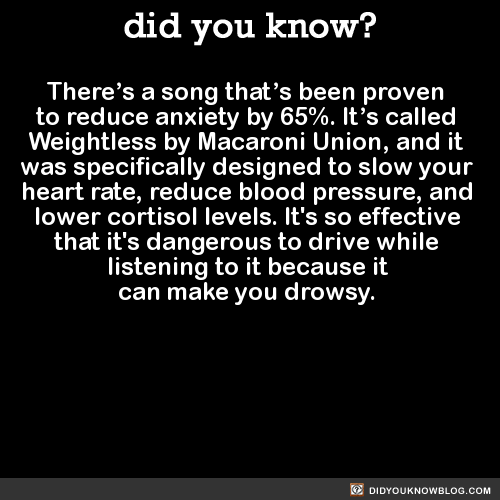
There’s a song that’s been proven
to reduce anxiety by 65%. It’s called
Weightless by Macaroni Union, and it
was specifically designed to slow your
heart rate, reduce blood pressure, and
lower cortisol levels. It’s so effective
that it’s dangerous to drive while
listening to it because it
can make you drowsy. SourceSource 2Source 3
Sound therapists and Manchester band Marconi Union compiled the song. Scientists played it to 40 women and found it to be more effective at helping them relax than songs by Enya, Mozart and Coldplay.
Weightless works by using specific rhythms, tones, frequencies and intervals to relax the listener. A continuous rhythm of 60 BPM causes the brainwaves and heart rate to synchronise with the rhythm: a process known as ‘entrainment’. Low underlying bass tones relax the listener and a low whooshing sound with a trance-like quality takes the listener into an even deeper state of calm.
Dr David Lewis, one of the UK’s leading stress specialists said: “‘Weightless’ induced the greatest relaxation – higher than any of the other music tested. Brain imaging studies have shown that music works at a very deep level within the brain, stimulating not only those regions responsible for processing sound but also ones associated with emotions.”
The study – commissioned by bubble bath and shower gel firm Radox Spa – found the song was even more relaxing than a massage, walk or cup of tea. So relaxing is the tune, apparently, that people are being Rex advised against listening to it while driving.
The top 10 most relaxing tunes were: 1. Marconi Union – Weightless 2. Airstream – Electra 3. DJ Shah – Mellomaniac (Chill Out Mix) 4. Enya – Watermark 5. Coldplay – Strawberry Swing 6. Barcelona – Please Don’t Go 7. All Saints – Pure Shores 8. AdelevSomeone Like You 9. Mozart – Canzonetta Sull’aria 10. Cafe Del Mar – We Can Fly
One of the comments suggests pairing it with Rainymood.
When I was literally unable to sleep at all, my senior at work gave me this song to listen to!
My wife uses this song when she’s having near-meltdown levels of anxiety right before bed and it helps her relax and shed some of that stress enough for her to attempt to lie down and sleep.
While it;s not a substitute for my meds, this song is really, really great for breaking the must-stay-awake cycle for me and really helps me sleep. There’a 10-hour version on yourtube.
You’ve heard of “making writing a habit,” and you’ve tried, but the pressure to write fills you with horrible pain and dread. You spend all your time wishingyou could write but somehow never writing. The “make it a habit” approach doesn’t work for you. But you still wantto write, maybe even regularly. Is there nothing you can do?
Here is an alternative approach to try. A rehab program, as it were, for writers with a psychological “writing injury” that has destroyed their desire to write and replaced it with shame, anxiety and dread.
If you have a writing injury, you probably acquired it by being cruel to yourself, by internalizing some intensely critical voice or set of rules that crushes your will to write under the boot-heel of “you should.” “You should be writing better after all the years of experience you’ve had.” “You should be writing more hours a day, you’ll never get published at this rate.” “You should write more like [Hilton Als/Jeffrey Eugenides/Octavia Butler/Terry Pratchett/etc.].” “You should write faster/more/better/etc./etc.”
You know what, though? Fuck all that. Self-abuse may have featured heavily in the cool twentieth-century writer’s lifestyle, but we are going to treat ourselves differently. Because 1) it’s nicer, and 2) frankly, it gets better results. My plan here is to help you take the radical step of caring for yourself.
1) First of all: ask yourself why you aren’t writing.
Not with the goal of fixing the problem, but…just to understand. For a moment, dial down all of the “goddammit, why can’t I just write?”blaringin your head and be curious about yourself. Clearly, you havea reason for not writing. Humans don’t do anything for no reason. Try to discover what it is. And be compassionate; don’t reject anything you discover as “not a good enough excuse.” Your reasons are your reasons.
For me, writing was painful because I wanted it to solve all my problems. I wanted it to make me happy and whole. I hated myself and hoped writing would transform me into a totally different person. When it failed to do that, as it always did, I felt like shit.
Maybe writing hurts because you’ve loaded it with similarly unfair expectations. Or maybe you’re a victim of low expectations. Maybe people have told you you’re stupid or untalented or not fluent enough in the language you write in. Maybe writing has become associated with painful events in your life. Maybe you’ve just been forcedto write so many times that you can no longer write without feeling like someone’s making you do it. Writing-related pain and anxiety can come from so many different places.
2) Once you have some idea of why you’re not writing…just sit with that.
Don’t go into problem-solving mode. Just nod to yourself and say, “yes, that’s a good reason. If I were me, I wouldn’t want to write either.” Have some sympathy for yourself and the pain you’re in.
3) Now…keep sitting with it. That’s it, for the moment. No clever solutions. Just sympathize. And, most importantly, grant yourself permission to notwrite, for a while.
It’s okay. You are good and valuable and worthy of love, even when you aren’t writing. There are still beautiful, true things inside of you.
Here’s the thing: it’s very hard for humans to do things if they don’t have permission notto do them. It’s especially hard if those things are also painful. We hate feeling trapped or compelled, and we hate having our feelings disregarded. It shuts us down in every possible way. You will feel more desire to write, therefore, if you believe you are free not to write, and if you believe it’s okaynot to do what causes you pain.
(By the way: not having permission isn’t the same as knowing there will be negative consequences. “If I don’t write, I won’t make my deadline” is different from “I’m not allowed not to write, even if it hurts.” One is just awareness of cause and effect; the other is a kind of slavery.)
4) For at least a week, take an enforced vacation from writing, and from any demands that you write. During this time, you are not permitted to write or give yourself grief for not writing.
This may or may not be reverse psychology. But it’s more than that.
Think of it as a period of convalescence. You’re keeping your weight off an injury so it can heal, and what’s broken is your desire to write. Pitilessly forcingyourself to write when it’s painful, plus the shame you feel when you don’t write, is what broke that desire. So, for a week (or a month, or a year, or however long you need) tell yourself you are taking a doctor-prescribed break from writing.
This will feel scary for some folks. You might feel like you’re giving up. You might worry that this break from writing feels too good, that your desire to write might never return. All I can say is, I’ve been there. I’ve had all those fears and feelings. And the desire to write did return. But you gotta treat it like a tiny crocus shoot and not stomp on it the second it pokes its little head up. Like so:
5) Once you feel an itch to write again—once you start to chafe against the doctor’s orders—you can write a tiny bit. Only five or ten minutes a day.
That’s it. I’m serious: set a timer, and stop writing when the time’s up. No cheating. (Well…maybe you can take an extra minute to finish your thought, if necessary.)
Remember: these rules are not like the old rules, the ones that said, “you must write or you suck.” These rules are a form of self-care. You are not imposing a cruel, arbitrary law, you are being gentle with yourself. Not “easy” or “soft”—any Olympic athlete will tell you that hard exercise when you’ve got an injury is stupid and pointless, not tough or virtuous. If you need an excuse to take care of yourself, that’s it: if you’re injured, you can’t perform well, and aggravating the injury could take you out of the competition permanently.
For the first few days, all of the writing you do should be freewriting. Later, you can do some tiny writing exercises. Don’t jump into an old project you stalled out on. Think small and exploratory, not big and goal-oriented. And whatever you do, don’t judge the output. If you have to, don’t even read what you write. This is exercise, not performance; this is you stretching your atrophied writing muscles, not you trying to write something good. At this stage, it literally doesn’t matter what you write, as long as you generate words. (Frankly, it would be kind of weird and unfair if your writing at this point was good.)
6) After a week, you can increase your time limit if you want. But only a little!
Spend a week limiting yourself to, say, twenty minutes a day instead of ten. When in doubt, set your limit for less than you think you’ll need. You want to end each writing session feeling like you couldkeep going, not like you’re crawling across the finish line.
Should you write every day? That’s up to you. Some people will find it helpful to put writing on their calendar at the same time each day. Others will be horribly stifled by that. You get to decide when and how often you write, but two things: 1) think about what you, personally, need when you make that decision, and 2) allow that decision to be flexible.
Remember, the only rule is, don’t go over your daily limit. You always have permission to write less.
And keep checking in with yourself. Remember how this program began? If something hurts, if your brain is sending you “I don’t wanna” signals, respect them. Investigate them, find out what their deal is. You might decide to (gently) encourage yourself to write in spite of them, but don’t ignore your pain. You are an athlete, and athletes listen to their bodies, especially when they’re recovering from an injury. If writing feels shitty one day, give yourself a reward for doing it. If working on a particular project ties your brain in knots, do a little freewriting to loosen up. And always be willing to take a break. You always have permission not to write.
7) Slowly increase your limit over time, but always have a limit.
And when you’re not writing, you’re not writing. You don’t get to berate yourself for not writing. If you find yourself regularly blazing past your limit, then increase your limit, but don’t set large aspirational limits in an effort to make yourself write more. In fact, be ready to adjust your limit lower.
When it comes to mental labor, after all, more is not always better. Apparently, the average human brain can only concentrate for about 45 minutes at a time, and it only has about four or so high-quality 45-minute sessions a day in it. That’s three hours. So if you set your daily limit for more than three hours, you may be working at reduced efficiency, when you’d be better off saving up your ideas and motivation for the next day. (Plus, health and other factors may in fact give you less than 3 good hours a day. That’s okay!)
Of course, if you’re a professional writer or a student, external pressures may force you to write when your brain is tired, but my point is more about attitude: constant work is not necessarily better work. So don’t make it into a moral ideal. We tend to think that working lessis morally weak or wrong, and that’s bullshit. Taking care of yourself is practical. Pushing yourself too hard will just hurt you and your writing. Also, your feelings are real and they matter. If you ignore or abuse them, you’ll be like a runner trying to run on a broken ankle.
I know I’m going to get someone who says, “if you’re a pro, sometimes you gotta ignore your feelings and just get the work done!”
NO.
You can, of course, choose to work in spite of any pain you’re feeling. But ignore that pain at your peril. Instead, acknowledge the pain and be compassionate. Forgive yourself if pain slows you down. You are human, so don’t hold your feet to the fire for having human limitations. Maybe a deadline is forcing you to work anyway. But make yourself a cup of hot chocolate to get you through it, literally or metaphorically. Help yourself, don’t force yourself. If you’ve had a serious writing injury, that shift in attitude will make all the difference.
In short: treat yourself as someone whose feelings matter.
This is the kindest writing advice ever. I love it.
This is amazing.
The same techniques can be used to help with a lot of life issues. As soon as you realise you are wanting to turn your back on something, that it hurts, then start with that ‘be curious’ step and take it from there. We feel like we feel for good reasons. So often the subconscious knows best. Please be kind to yourselves and learn to listen in. It’s worth it in the long run. (Sending so many hugs!)
If you’re scrolling through tumblr trying to distract yourself from something you don’t want to think about or you’re looking for a sign that everything will be okay, this is it. So, breathe. Relax into this moment. You’re alive & that’s all that matters.
There’s a song that’s been proven
to reduce anxiety by 65%. It’s called
Weightless by Macaroni Union, and it
was specifically designed to slow your
heart rate, reduce blood pressure, and
lower cortisol levels. It’s so effective
that it’s dangerous to drive while
listening to it because it
can make you drowsy. SourceSource 2Source 3
Sound therapists and Manchester band Marconi Union compiled the song. Scientists played it to 40 women and found it to be more effective at helping them relax than songs by Enya, Mozart and Coldplay.
Weightless works by using specific rhythms, tones, frequencies and intervals to relax the listener. A continuous rhythm of 60 BPM causes the brainwaves and heart rate to synchronise with the rhythm: a process known as ‘entrainment’. Low underlying bass tones relax the listener and a low whooshing sound with a trance-like quality takes the listener into an even deeper state of calm.
Dr David Lewis, one of the UK’s leading stress specialists said: “‘Weightless’ induced the greatest relaxation – higher than any of the other music tested. Brain imaging studies have shown that music works at a very deep level within the brain, stimulating not only those regions responsible for processing sound but also ones associated with emotions.”
The study – commissioned by bubble bath and shower gel firm Radox Spa – found the song was even more relaxing than a massage, walk or cup of tea. So relaxing is the tune, apparently, that people are being Rex advised against listening to it while driving.
The top 10 most relaxing tunes were: 1. Marconi Union – Weightless 2. Airstream – Electra 3. DJ Shah – Mellomaniac (Chill Out Mix) 4. Enya – Watermark 5. Coldplay – Strawberry Swing 6. Barcelona – Please Don’t Go 7. All Saints – Pure Shores 8. AdelevSomeone Like You 9. Mozart – Canzonetta Sull’aria 10. Cafe Del Mar – We Can Fly
One of the comments suggests pairing it with Rainymood.
When I was literally unable to sleep at all, my senior at work gave me this song to listen to!
My wife uses this song when she’s having near-meltdown levels of anxiety right before bed and it helps her relax and shed some of that stress enough for her to attempt to lie down and sleep.
While it;s not a substitute for my meds, this song is really, really great for breaking the must-stay-awake cycle for me and really helps me sleep. There’a 10-hour version on yourtube.
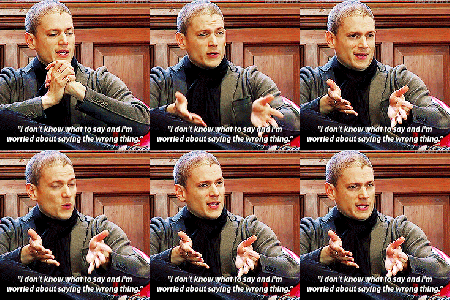
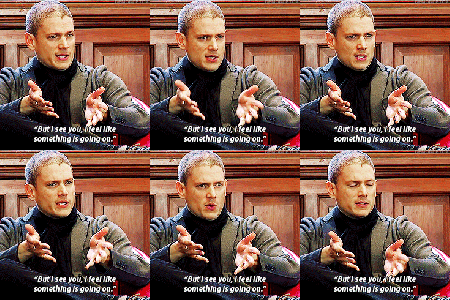
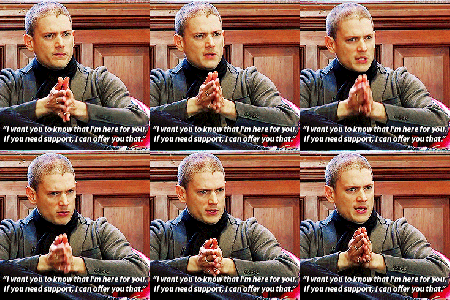
“In that way, you’ve acknowledged that you’re unsure, that you don’t know what to do or say. You’ve acknowledged that you see them. They feel seen. They feel heard and acknowledged, which is huge for someone who’s in crisis.” Wentworth Miller | Q&A at Oxford Union | 2016 | x
This is…actually the most beautiful and helpful advice, honestly.
Did you know: Chris Evans gets panic attacks. Yes, he does. This is one reason why he’s very private and didn’t really do any meet-and-greets on the Avengers’ sets.
It amazes and inspired me that a man who does what he does can do it, even with an anxiety disorder. You go, Chris.
This is why I get so upset when I hear negative comments about Chris and how he doesn’t seem as out-going as the rest of the Avengers cast. I remember hearing people complain about how he’s ‘rude’ and the like and it’s sad, because I highly doubt he intends to come off that way, he’s just more reserved than the others.
I remember hearing once that he actually went to seek psychiatric help before accepting the role of Captain America because of how anxious he felt regarding it. As well as the fact that he already played another Marvel superhero and he was concerned how comic fans would react to his playing another hero in that universe.
Just because someone’s in the entertainment industry doesn’t mean they’re going to be incredibly outgoing off camera just as much as they appear to be on camera. Some people just really enjoy acting; they’re not the characters they portray nor are they like their costars nor are they going to be incredibly outgoing because of their choice of career.











 Tumblr Exodus