Women’s anger isn’t pretty or useful to men. It prevents them from cheering their male superhero on from the peanut gallery; it makes them unattainable in a way that’s not because the hero is being admirably noble. Also, it makes their faces go all scrunchy, and we can’t have that; never forget Jessica Alba being told to “cry pretty” on the set of Rise of the Silver Surfer, or, more recently, Joss Whedon telling Elizabeth Olsen to keep her face calm during Age of Ultron’s fight scenes because an angry, combative face was unattractive.
There’s a reason women love Agent Carter, a show powered by a subtextual engine of Peggy’s grief, frustration, and rage. There’s a reason Laurel Lance never clicked as a character until her largely incoherent but still deeply satisfying Season 2 rage spiral; life has done her wrong, and she’s finally, finally hitting back. There’s a reason so many readers are proudly labeling themselves non-compliant. We so rarely get to see our own anger reflected in mass media, and when we do, it’s deeply cathartic.
I’m so ready for Jessica Jones to be furious for a whole 13 episodes of her first season. I’m hoping Karen Page gets to be as livid as Foggy was when she finds out that Matt is Daredevil. I want Sara Lance to come back from the grave as spitting mad as she was when she went in, and I want Laurel and Thea and especially poor Felicity, sadly defanged by her romantic entanglement with Oliver in Season 3, to get and stay angry with Oliver when he inevitably does something dishonest or ethically dubious. Even Supergirl – as sunshiney as Kara seems, and as I want her to be, I also want her to be allowed to get pissed when the situation warrants it. Girl’s got laser-eyes for a reason.
I’m so excited for this coming year of superhero TV to bring me Supergirl, and Jessica Jones, and Peggy Carter, and Speedy and Hawkgirl and two different Canaries. And I’m excited for the supporting stories of Iris West and Karen Page and Felicity Smoak and Caitlin Snow and Alex Danvers and Angie Martinelli.
But God, I hope they get to be angry this year. Because these women have been through enough to make them mad as hell. And I don’t want them to have to take it anymore.
Who’s Pam? Doesn’t matter. Pam will make three billion dollars.
i would pay to see this
are you fucking kidding me I WANT this movie
I want to see this cheerful lady walking through fire and being badass and sweet
and most of all I want her to save the day with the normal shit she’s toting in that bag.
I NEED this.
‘Let me get this straight. You’re saying our Xanderian captor is in pain from a swollen… thing, and is going to eject us from the airlock? Well why didn’t you say so? Here, hun, I think I got some Aleve in here. You just take that.’
*Alien collapses frothing*
Everyone stares at her in awe. ‘How did you know that naproxen is fatal to Xanderians?’
‘Honestly, you people never have children? I hear EVERYTHING.’
or
‘Oh dear, you need something to bridge to gap between circuits and stop the shortage? I know I got a safety pin, just wait.’
*Ship jumps to warp ahead of pursuit*
Like, seriously, I want her to fucking MacGyver whatever is needed to resolve the plot issues, using Clorets gum, her Kindle, a Starbucks receipt (tall caramel macchiato) and a handful of change and lint.
Because we got so many ‘ordinary’ guy heroes that go on to be extraordinary, and let’s be real – in an actual Holllywood movie Pam would scarcely rate a speaking part. I want a female hero who is a hero without needing a goddamned makeover and just needed the right circumstances to shine. I am up to my goddamn neck with ordinary dude heroes. I’m sick of them. I know everything about them already.
Sam never saw himself as a hero – not even when his father
spat the word at him, the night Sam’s family took him out for dinner to
celebrate his summa cum laude and
discovered he’d applied for the USAF instead of the MA/PhD.
“Just an act of rebellion,” his mother said, because Sam’s
mother had fifteen books on the ‘feminine in the masculine’ and ‘understanding
Oedipal mirroring in a post-structural world’ and she’d written the last three.
“Be glad he didn’t join a gang, Gerald.”
Sam was handpicked by the government halfway through Basic Training,
plucked from ranks of exhausted young men and one woman – the creation of masculinity through the oppression of the feminine,
his mother would have said – and his new CO clapped him on the shoulder. “Your
parents must be proud,” he said, and Wilson didn’t bother to inform the man
that his parents expected him to come home with tattoos and bricks of cocaine.
He went home with a tattoo, the Falcon unit crest over his
bicep, virtute alisque above it, No One Comes Close in the scroll below.
His father sniffed and went back to his medical journals, and his mother asked
if there had been a ceremony, perhaps some ritual consumption of alcohol in
this process of manhood.
Sam’s mother had sat them all down with articles on womanhood
when Sam’s older sister got her first period. They had celebrated the new stage
in her life and each handed her something useful to help her on her path –
Celeste had muttered to Sam that new
parents would be useful, but no one else heard – and Sam had never been so
glad to be a boy, until his mother had suggested they hold a similar ceremony
for everyone’s sexual awakening.
Reilly, though. Reilly was always meant to be a hero.
Michael O’Reilly was built like Captain America, over six feet tall with dark
hair and a broad grin, bright eyes that crinkled at the corners even when he
wasn’t smiling, dimples in his cheeks and a booming voice. There was something
about Reilly’s face that made people take a second look, that kept the whole
base staring for a little too long.
Reilly had designed the tattoos; he’d enlisted fresh out of
high school, five years in to Sam’s one, planning to fly until his wings or his
heart gave way. His older brother had joined the Marines, like their Dad, and
Reilly had gone for the Air Force to honor the grandfather who’d died over Nazi
Germany. (At least, that’s what he told everyone who asked. After meeting
Reilly’s older brother, Sam’s degree in psychology and Dr. Annette Cole Wilson’s
books suggested that Reilly had joined the Air Force to harass his water-bound
brother from the sky.)
Sam went home with Reilly for Thanksgiving the second year,
because the first year Reilly had talked nonstop through long days in theater
about his mother’s pie, and the Wilson family didn’t celebrate holidays that
reified the genocide of minorities. (In fourth grade, Sam’s teacher had asked
them to write an essay on Valentine’s Day, and Sam Wilson had argued that it
glorified violence done to corporate Italian bodies. Ms. Kupperman had not been
impressed.) Mrs. O’Reilly had met them at door, completely dwarfed by her
husband’s bulk and her American sons.
Embarrassingly, Sam had stood there with his mouth open for
longer than the son of Drs. Cole Wilson should have, shocked to see Reilly
sweep the tiny, smiling Asian woman into his arms and shout, “May!” (It was
another year and several more dinners before Sam learned that Mrs. O’Reilly’s
name wasn’t ‘May,’ and that he’d been calling Reilly’s mother ‘mẹ’
since they’d first met.)
“I told you my parents met in ‘Nam,
birdbrain,” Reilly laughed, taking Sam’s speechlessness with his usual grin. “What
did you think I meant?”
“I thought she was a nurse!” Sam
defended himself, and felt his cheeks heat up when Mr. O’Reilly winked and
said, “Oh, son, she was.”
It turned out that Mrs. O’Reilly made a mean Thanksgiving
dinner and seemed unconcerned with the commemoration of cultural extermination.
“It’s a good dinner,” she told him, when Sam asked, patting his cheek and
spooning more gravy onto his plate. “All my kids home. I show you pictures
later, my boys in school play. Mike was big turkey.”
Michael O’Reilly had indeed been a large turkey in his first
grade play. Michael O’Reilly had been a hero, from the insults he had fought as
a child – Reilly and his brother on the playground, slant-eyed kids with the mother
who couldn’t talk right, just like Sam had been the black kid in his private
school, the kid that didn’t know how to be black when their mother made them
volunteer at the youth center when he was a teen – to the wars he had tried to
end at just eighteen.
The thing about heroes, though? They never stick around long
enough to collect the medals they earn. Sam had stood on the stage next to
Reilly’s brother, both of them buttoned into their military best and choking
for air, the wrong Reilly accepting the cold, metallic honors his little
brother had earned while their mother sobbed against Mr. O’Reilly’s shirt.
Sam meets Steve Rogers in July, goes on the run a week
later, phones home from a burn phone to let his parents know he’s all right.
Annette Cole Wilson wants to know if this rebellion is to reinforce the
boundaries of masculinity in a militaristic setting, and Gerald Wilson tells
them to stop by and stock the first aid kit before they go.
In November, he puts down his gun and shakes off his wings
and brings the team to mẹ’s. “Where
are we going?” Steve asks, broad shoulders and a hero’s bright eyes.
“To look at some pictures of a big
turkey,” Sam tells him, rubbing at the wings of his tattoo. “And eat some pie.”
Mrs. O’Reilly meets them at the door,
light as a feather when Sam scoops her into his arms, a soft smile for the pack
of fugitives behind him, vivid aubergine lipstick and her son’s twinkling eyes.
“You stay for dinner,” she commands, beckoning them in, reaching up to pat Sam
on the cheek, rubbing her thumb at the damp spot under his eye. “All my kids
come home.”
I did not deliberately set out to make my past few months’ nonfiction reading into a rec list for a more in-depth look at the political issues addressed in Captain America: The Winter Soldier. Honest. (Mostly honest. The Paperclip book might’ve caught my eye in part because of the shoutout in Cap 2.) But one of the reasons I fell in love with the movie was the great big middle finger it gave the American national-security complex… and then when I was tumbling ever further down the nonfiction rabbit hole and things started sounding eerily familiar, I realized, duh, the scriptwriters for TWS were probably reading a lot of the same books I was.
I don’t make any claim that this is an exhaustive list. As noted, it’s a straight-up list of books I’ve picked up recently, so I have no doubt there are other relevant ones I’m missing. But it’s a pretty solid overview. So without further ado, I give you: the “Actually, a Hydra conspiracy would be less disturbing” national security reading list.
Jane Mayer – The Dark Side: The Inside Story of How the War on Terror Turned Into a War on American Ideals.
Tom Engelhardt – Shadow Government: Surveillance, Secret Wars, and a Global Security State in a Single-Superpower World.
Dana Priest and William Arkin – Top Secret America: The Rise of the New American Security State.
Annie Jacobsen – Operation Paperclip: The Secret Intelligence Program that Brought Nazi Scientists to America.
More detailed writeups and a bit of a rant under the read-more link. (Gist of the rant: The best and scariest thing about Cap 2 is that the most disturbing things about SHIELD/Hydra are 100% based in fact.)
Coming back to this list, I’d also like to add Bruce Schneier’s Data and Goliath: The Hidden Battles to Collect Your Data and Control Your World. Schneier is no paranoid crank or partisan hack; he’s been a well known, widely respected computer security expert since the mid-late 90s, and he has a knack for distilling very technical issues down to the essentials of what it all means and why it matters. He’s also a reliably lucid voice on broader issues of security, risk, fear, the establishment of trust, and the foundations of civil society.
I’m telling you all this because the apocalyptic wasteland described in this book, which will make you want to flush your phone down the toilet and never drive or take public transit anywhere ever again, is actually a pretty restrained take on the situation from a guy who knows what he’s talking about and understands the needs, stakes, and motivations of all parties involved.
(Notably, Schneier does not encourage you to flush your phone down the toilet, or up stakes and move to a bunker in Montana. Part of his point is that if seeing the very tip of the data-exploitation iceberg makes you feel like you have to, something is horribly out of whack and there’s no actual reason Certain Parties need to be given unfettered, unsupervised access to every single thing they ask for.)
Zola’s algorithm is already out there, more versions of it than anyone knows how to count, ticking away in the cloud. To paraphrase a different Schneier quote, it’s bad civic hygiene to sit around waiting for someone to decide that building death helicarriers out of it would be a great way to keep the world safe.
Peggy Carter’s grave is filled so quickly by her friends and family that they don’t need gravediggers
Tony Stark sometimes wonders if the Arc Reactor could be marketed to synagogues as a Ner Tamid
Pepper Potts’ grandfather called her “Peppila”
The first time Bruce Banner comes back from his transformation, he says the
Shehecheyanu
In Israel, people call Thor “Makebet” and he is known to get an inordinate number of Hanukkah party invites
Natasha Romanoff can pull herself out of flashbacks by reciting the shema
Clint Barton only goes to synagogue on Kol Nidre, and won’t let anyone go with him
Nick Fury’s hebrew name is Niv Amichai, for his grandfather
THIS IS SUCH A GOOD
Magneto says the shema when anything vaguely dangerous starts happening. It’s a habit. He recites it under his breathe more out of habit that anything else now, he’s suffered but at least he’s alive. He’s genuinely surprised when he watches Billy do the same thing years later.
Tommy and Pietro compete to about can read
haggadah passages the fastest so they can get to food sooner.
Wanda uses her powers to show “animated” versions of the stories to the her and Pietro’s children every holiday.
Kitty will get vegetarian options if they’re at a non kosher restaurant.
Robbie Reyes worries for months about whether or not he’s able to step into a shule after becoming the Ghost Rider because he knows Gabe’s Bar Mitzvah is coming up (via @russianspacegeckosexparty )
Elijah Bradley makes sure to light Yartzeit candles for his grandfather every year.
Isaiah Bradley is extra proud to be going against Nazis, because he knows he embodies every last thing they hate, and that he will win.
Kate Bishop had a super fancy Bat Mitzvah party, and no one realizes her favorite part of the whole day was receiving the silver wine glass handed down on her mother’s side.
What’s cool about that scene is that you can actually see the different kinds of baseline power and skill when each person fights against Bucky! It creates a situation where each superhero, just as they are, has to fight without warning.
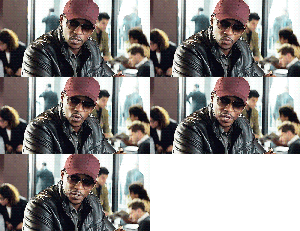
Sam gets taken out immediately because the Soldier sneaks up on him. He didn’t get a chance to think or plan, which is how Sam operates in a fight – in CATWS, he came from behind and took out the HYDRA soldiers. But as soon as he’s conscious, Sam makes a tactical decision, just like a soldier: he goes after Zemo, because he knows he can’t take Bucky on without any gear. Sam recognizes the distraction for what it is – Zemo’s escape:
Tony fights intelligently, using the environment to his advantage. He sneaks up on Bucky, uses sonic and flash bombs, and anything he grabs becomes a weapon. He also twists the battle to always centre around his tech, which takes split-second calculations in a fight. But when that tech fails… physically, Tony is just a regular man, and he’s easily defeated.
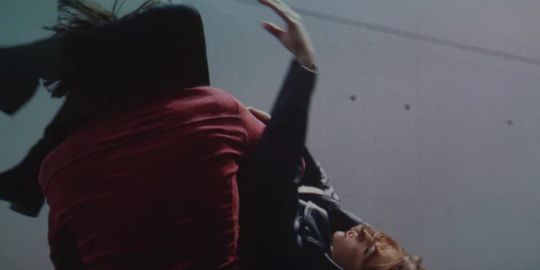
Then Sharon fights. She’s FBI trained, bold and unafraid, and could easily take down a skilled fighter… but she’s only human, and she’s inexperienced in fighting enhanced beings. She’s also not skilled enough in her fighting style – her movements are more about force (which does nothing to Bucky, being inherently stronger). When she tries to bring Bucky down, Sharon puts her weight onto Bucky’s metal arm, and uses her fists to fight, so Bucky just shakes her off. It’s not enough.
Natasha takes over, and you can see the difference immediately: she’s exceptionally skilled in combat and has been trained to fight enhanced beings. She sneaks up on Bucky while he’s distracted with Sharon, hitting vulnerable areas and then backing out of his range. Natasha uses her Widow move, coming at Bucky from behind, using his human arm for leverage so he can’t toss her off, and she gets quite a few hits to Bucky’s head using her elbows, not her fists. Nat isn’t enhanced, but she’s holding her own… until Bucky defeats her with the metal arm. But I find their fighting styles to be eerily similar.
T’Challa then enters the fray. It’s now Enhanced vs Enhanced, and you can see how the playing field levels in terms of physical strength: T’Challa’s punches are more effective, and his hits cause Bucky to stumble. But T’Challa underestimates Bucky’s strength, likely because he’s never fought The Soldier before now. He’s also inexperienced compared to Bucky, because he’s young and new at this; you can see him experimenting in his attempt to subdue Bucky. It’s a time-consuming fight, but Bucky would have won in the end. So there’s potential – T’Challa thinks on his feet and is a skilled fighter – but without the suit, he’s not quite there yet.
And, like all of them, T’Challa is only trying to detain Bucky, not kill him… but the Winter Soldier is willing to kill them, and that makes a huge difference. The caged animal is always going to be stronger and more volatile, and that automatically gives Bucky an edge.
What the Winter Soldier doesn’t realize, though, is that Steve is in the same boat; he doesn’t care what has to be done, as long as he gets Bucky back. After he gets over the initial shock of Bucky’s mindcontrol, Steve is a formidable opponent: he’s enhanced, he’s skilled, he’s experienced, he’s familiar with the Soldier’s fighting style… but mostly, he doesn’t care if he lives or dies. He’ll go down with Bucky if that’s what it takes. And that’s where Steve wins over the Soldier: his love for Bucky gives him that upper hand.
(Okay, I went off on a tangent. But I just really like that scene!)
















 Tumblr Exodus