ARGH this is an excellent questions, and one I’ve been thinking a LOT about.
I guess, it depends on your views of “gay-baiting” and whether its the creators’ intention, or the fact that they still benefit from it.
Here’s what I mean:
My wife araniaart and I have had conversations with both the author and the artist for Planet Hulk and they have said things that imply to me that they are limited by what they can do with the Steve/Bucky relationship. I don’t want to put words into their mouths, but it certainly seems to me that both of them would have gone “all the way” with the Steve/Bucky relationship if they had been allowed to. This leads me to believe when you write Steve Rogers, there’s a “No homo” clause that comes with it from Marvel. So, I don’t think Sam Humphries or Marc Laming are trying to “Gay bait” anyone – I personally think they are trying very hard to get away with what they can.
But that being said, because the creators are crippled by Marvel’s insistence on reaffirming Steve Roger’s heterosexuality despite decades of homoerotic overtones, does that still count as gay-baiting? I don’t think Marvel is naive enough to think that they don’t know exactly what they are doing; that while they seem adamant that Steve Rogers is 100% straight, they HAVE to be aware of their fanbase that thinks otherwise, right?
So, they still get all the benefits of whipping the queer audience into a hopeful frenzy, while being able to have plausible deniability of there actually being any genital-touching between Steve and Bucky.
So, in that way, yeah it kind of is gay-baiting.
BUT AT THE SAME TIME… after Planet Hulk its going to be very hard to deny that there is a distinct sub-set of Captain America fans that FIRMLY believe Cap is queer, and they can (and should) use Planet Hulk as pretty form evidence that the creators are “in on it.” I mean, the comics code didn’t allow any gay characters in comics in the 80s, but authors still managed to do a whole story arch about Steve’s childhood BFF Arnie who was gay and asked Steve to help save his lover. They never SAID Arnie was gay, but it was so thinly veiled that no one can reasonably go back and read that arc and think it wasn’t intentional.
Its this glass closet that I think Planet Hulk is fated to live in. I don’t think they will be able to actually SAY or SHOW them being a canon couple, but in a few years as queer and female audiences for comics continue to grow, I think everyone will look back to Planet Hulk with the assumption that this was the first time Bucky and Steve were WRITTEN as a couple.
I think Steve coming out as bisexual is only a matter of time. 3 years, 10 years, 20 years? Who knows, but I think its going to happen eventually, even if its only in the AUs or alternate properties. I think Planet Hulk and the upcoming Captain America: White will be the tip of that iceberg.
Tag: meta

rifa:
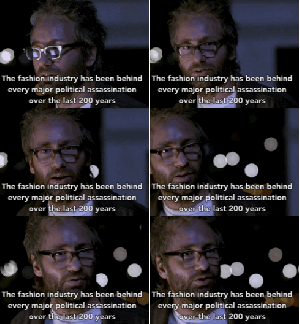
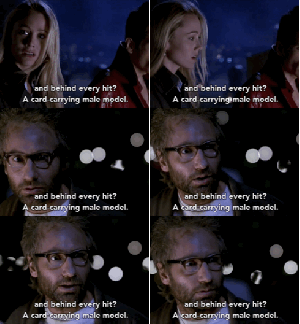
seems legit.
Zoolander: the gift that keeps giving.
This is everything I have ever wanted from the internet
this is it this is the best Winter Soldier post, congratulations everyone, we did it
My question is: what is Steve Rogers’s body count?
…
We don’t talk about that a lot because he’s an American Hero ™ and American Heroes don’t ever actually kill people even when they’re, you know, soldiers in the actual fucking Army. The American Hero has to show mercy and give everybody a second chance and any time the Bad Guy dies, it has to be because he made a mistake that lead to his own death. The hero can never actually just fucking murder him in our stories because that would be wrong and a true American would never do something like that.So, like, has Steve Rogers ever shot a dude in the face? Has he ever snapped anybody’s neck? Has he ever been struggling for his own life and used his shield to take a life?
If you have either canon comics knowledge or just Opinions and Feelings, please feel free to share. Because, like, dude was a soldier in WWII on the European Front fighting Nazis, kicking open doors with gun literally blazing, so he’s obviously killed people, but we never discuss this. How does Steve reconcile killing? Does he feel guilt? Is he comfortable with his actions? Has he killed people since he got pulled out of the ice? How does he feel about taking human lives? Does he talk to anybody about it? Does he just internalize it and let it eat him up inside?
This is an excellent question, so I decided to look into it (in MCU, not the comics, sorry). Turns out it’s incredibly difficult to determine Steve’s on-screen body count because 99% of his kills are unconfirmed/ambiguous—which, given that Marvel is now owned by family-friend Disney, is obviously deliberate, and made easy by the fact that Steve’s weapon of choice is his shield (blunt force trauma, no penetration, leaving no obvious marks). A metal Frisbee doesn’t look like much of a weapon, right?
However, as a traumatologist in spe, I know for a fact that a shield thrown hard enough to embed itself in a metal bulkhead would definitely kill anyone it hit, especially if—as here—it’s aimed directly at the person’s head:
There’s a good chance almost everyone Steve hits with the shield full force ends up dead/severely incapacitated and probably disabled for life.

Could be a thing
Hey there all you beautiful crazy beings. I unfollowed a bunch of you because in your excitement you forgot to tag.
A lot.
Many times.
I can totally understand the mania of a new tidbit or outrage or whatever grabbing your soul and you need to reblog or post about it. However, I also respect my want and need to not see that material for whatever reason. I don’t need to justify to you why I need it and you don’t have to tag but I won’t be following you even though that means I will miss you and your other brilliant or fannish stuff.
[Editor’s Note: The author of this piece is a former Marvel employee and wishes to remain anonymous.]
Disney does not care about Marvel’s female market, which makes us virtually invisible. I could probably populate Pluto with the amount of Princess items Disney makes. But where are Gamora and Black Widow? This exclusion of women from Marvel movie merchandise is completely purposeful. I know; I was there.
While working at Marvel post-acquisition, I saw a deck circulated by Disney’s Brand Marketing team. I’m prohibited from sharing the slides, but the takeaway is that, unlike the actual demos, the desired demographics had no females in it whatsoever. I asked my supervisor why that was. Ever the pragmatist, he said, “That’s not why Disney bought us. They already have the girls’ market on lockdown.”
I’d entered the comics industry because I was a comics fan. It hurt to see so plainly that to Disney, people like me didn’t matter. My demographic was already giving them money anyway, with Disney Princess purchases. Even now, there’s no incentive to make more Marvel merch for women, because we already buy Brave and Frozen products.
This does not come as a surprise, really. Anyone who knows about branding and marketing can tell you how most gender-skewed business models work (and most businesses are gender-skewed). It starts when we’re babies. Blue for boys, pink for girls. Separate, but equal. Sound familiar?
Disney bought Marvel and Lucasfilm because they wanted to access the male market. To achieve this goal, they allocate less to Marvel’s female demo, and even less to a unisex one. They won’t be interested in changing how they work until consumers understand what’s going on.
So let’s delve deeper into how licensing works. To obtain a Marvel license, you typically have to be a successful company with access to big distribution channels, like Wal-Mart, Carrefour, Target, Tesco, etc. Marvel sometimes licenses to smaller companies, but the contracts work the same. There’s a minimum guarantee, royalty rates, and a payment schedule.
Most contracts never fall below $100K for a minimum guarantee, and large companies like Hasbro will pay millions over the course of a few years. Royalty rates vary by style guide and distribution channel. Movie style guides tend to have a higher rate due to actor likeness fees, and the standard royalty rate is about 12%. To pay Marvel $25K, a licensee has to make over $208K. Moreover, they need to pay their employees and manufacturers and make a profit. For Marvel movie properties, licensees need to make as much money as possible in a short amount of time. Movie characters are hot only for a few months, so both Disney and the licensees will resort to what they know best: the “separate, but equal” strategy.
Now that my short intro into licensing is over, how do we change things? When complaining about the lack of Black Widow, don’t just tweet at Marvel and Disney. Contact the licensees. They need to know there is a high demand. They need those numbers. Look into companies like Mad Engine, Hasbro, Jay Franco, etc. Look at the tags and find those companies. Demanding Frozen products for boys would be a balanced, conjunctive step.
Another route is to create your own company and get a licensing contract. 3D printers for clothing will soon be available. Save enough capital to buy one and you could flood the market with apparel that feature the Avengers, Justice League, and Guardians of the Galaxy as they were meant to be: co-ed teams.
Personally, I don’t think we need Marvel, DC, or Lucasfilm to pave the way for us. Giants will only move when there are other giants around. For example, when an indie film becomes successful it makes waves and influences the rest of Hollywood. HerUniverse and WeLoveFine are already successfully paving the way for women’s licensed clothing lines. We need more independent content that spotlights women heroes, super or otherwise. Hellboy, Wanted, and The Green Hornet didn’t break into the billions, but they are good examples of putting another horse in the race.
Content is queen. The most lasting way to change what’s around you is to create something new. So, comics creators —especially women—more spectacular women superheroes who headline their own books from Image, Dark Horse, Oni, Top Cow, you name it, would also be incredibly helpful. And indie pubs, make those comics and pitch them to Focus Features, Lionsgate, New Line and so on.
It’s time to start getting creative about our strategy. Let’s all brainstorm and share tactics. In the immortal words of Audre Lorde: “The master’s tools will never dismantle the master’s house.” It’s time to make our own tools.

Unpopular Ship?

Unknown ship:
Trying to get other people to ship your ship:
Ship remains non-canon?
Ship remains non-canon part 2:
You ALMOST Ship something:
Someone ships something you don’t ship?
Someone insults your ship:
Ship becomes canon:
What is the conclusion? Jack Sparrow is a Shipper.
No, Jack Sparrow is the entity of “shipping”.
When someone shoots your ship down:
that’s CAPTAIN* Jack Sparrow to you
The ALMOST ship is my everything


unnecessary sex scenes in movies

unnecessary sex scenes in tv shows
unnecessary sex scenes in fanfic


Not to my taste
Saying ‘this didn’t work for me’ isn’t hate.
Saying ‘I didn’t buy the relationship’ isn’t hate.
Saying ‘This part worked for me but this didn’t’ isn’t hate.
Not liking something isn’t a crime, isn’t hate, and won’t get your fandom card revoked. I promise. Saying certainly isn’t wrong either. There is a very pervasive culture to not critique in fandom because it is a gift culture and saying no to a gift or complaining about it, especially in the USian culture I grew up in, simply isn’t done.
Online fandom is not that, folks. It is perfectly okay to not like something and say you don’t like it. We engage in critique of popular culture by writing fanfiction, creating fan art and writing meta. Responding to fanworks is just another form of interacting with that.
I have been in fandom for a very long time now (let’s just say BSG, the original, was on the air) and I see this every so often. Please, just step away from the keyboard for a day or two and think about if you are going to remember this is a week, month or year (I bet you won’t).
Someone not liking the same things as you IS OKAY. SAYING IT IS OKAY.
Supersoldiers, Alcohol, and Drugs
Expanding on my last post about supersoldier metabolism… bear in mind I’m not a doctor or a nutritionist, just an enthusiastic and curious amateur, so I welcome input or corrections.
So. Couple of questions. Enough about the raw calories required for supersoldiering… What about alcohol? What about painkillers? It’s NOT the case, I don’t think, that ‘supersoldier metabolism is just too fast for them.’ I think there’s a lot more going on.
1. We need to consider that individual response to alcohol is ALREADY variable: different people can metabolize alcohol more or less well. Much of our ability to metabolize alcohol usefully is genetic. So genetic modification could easily fix any problems that occur due to the byproducts of oxidizing alcohol.
2. Second option is that supersoldiers’ enhanced healing ability comes in and ‘cleans up’ the tissue damage caused by these byproducts. Presumably that’s just the result of enhanced immune function.
OK. Now what about the common canonical issue with supersoldiers and how their ‘metabolism’ gets rid of drugs or reduces the effect.
1. Let’s consider opioids. These work similarly to the body’s own painkillers. Easy reason this might not work well with supersoldiers? Frankly, it’s very likely that their bodies undergo such chronic acute trauma that they actually develop a tolerance to their own endogenous opioids. Thus, exogenous painkillers wouldn’t work except in massive doses–and it would be a vicious cycle, as, presumably, supersoldiers ALSO adapt more quickly to increased dosage and would become tolerant to THAT, too. I like this theory because it explains how they aren’t necessarily sustaining less damage or feeling less pain than a normal person would; they’re simply healing faster. Therefore, it makes sense that their internal painkilling drugs wold have to work overtime and that they would develop a tolerance to their own pain-suppressing neurochemicals.
2. Aspirin or other anti-inflammatories: seems pretty straightforward. The endogenous anti-inflammatory response is too fast to need ‘help’ from aspirin or ibuprofen. MAYBE they have enhanced ability to convert omega-6 fatty acids to omega-3 to take advantage of eicosanoids/other stuff that fights inflammation, etc. Or maybe SHIELD nutritionists/HYDRA nutritionists(??? dude HYDRA NUTRITIONISTS I want that job) give Captain America/The Winter Soldier a lot of fish oil. Well hey, the Russians eat a lot of smoked fish!
oh my god now I want to write a fanfic where a HYDRA nutritionist recommends they feed the Winter Soldier more herring that would be amazing.
ETA: oh my god it would be RED herring if the Russians gave it to him.
ETA 2: this sounds like a Hydra Trash Party fic (”Brock Rumlow feeds the asset a herring”) except it would just be literally a freaking herring.
P.S. I have way, way more thoughts on all of this but it’s getting a little technical…
Supersoldier Metabolism Headcanon (+ Actual Science)
I’ve been reading a lot of fics that handwave the ‘supersoldier metabolism’ (Captain America, Winter Soldier). Some thoughts.
1. There is startlingly little variance in actual metabolism, aka BMR, among normal human beings (steroid users are KIND OF outliers, but primarily all that changes is that more surplus calories go to muscle tissue, not fat–so, sort of like supersoldiers). What variance in BMR there is may be attributed to lean tissue increase (aka, more muscles more burn) and increased activity even if it’s unconscious (NEAT).
2. The astounding amounts of food some athletes eat are attributable primarily to their ability to tolerate huge workloads. I.e. if Michael Phelps weren’t so fast a swimmer and thus able to swim so far and so hard in a single session, he wouldn’t burn calories like he does when training. (And, indeed, when he isn’t training, he doesn’t have to eat that much). So it’s not like if Captain America lay around doing nothing he’d still need that much food. But when he’s running a half-marathon in 30 minutes, he’d be burning just as many calories as if a normal 240-pound man ran a half marathon in an hour and 30 minutes. [By the way, that’s me being very generous… I’ve never met a 240-lb man who can run a half marathon in 1:30. I weighed about half that much when I did it myself, that’s a sub-7:00-mile pace.] So that would mean he’s burning roughly 2400 calories… in THIRTY MINUTES. Think about that. It’s not that his resting metabolism even needs to be so high–it’s that he’s able to do this superhuman feat and that requires tremendous energy.
3. I think probably supersoldiers are just super-fit. Their mitochondria are able to synthesize ATP at an unprecedented rate. NOW, seeing THAT, you might think: okay, so they require a lot of carbohydrate, but what happens if they didn’t pack a Power Bar? (First of all, they very likely do keep extra fuel on hand). Also–why don’t they waste away if deprived of food?
4. Well, because they’re probably metabolically FLEXIBLE. I imagine they are able to use ketones for fuel more efficiently than normal people, for one thing–i.e. can use fat for fuel more efficiently than normal humans, vs. relying on carbohydrate; some ultra-endurance athletes train themselves to do this. There has been some interesting, though potentially sketchy, research on exogenous ketones as a performance enhancer, too. I guess with supersoldiers they might be endogenous! (exogenous–supplied from outside; endogenous–produced in the body) Some of this research was about enhancing Navy SEALs’ ability to perform in depth dives. Hey, maybe that’s how the Winter Soldier rescued Cap.
5. I also imagine supersoldiers may be able to metabolically downregulate more quickly than normal humans do–i.e. their BMR can radically adjust itself. And finally, they can store more glycogen than normal people. But really, burning fat more efficiently would be the most likely explanation, since so many thousands of calories of fat are available on even relatively lean people (and note that I don’t think the superheroes are sub-7% bodyfat! Note that actual soldiers are not meant to attain very low body fat, as it’s a liability in the field).
6. By the way, metabolic flexibility/the idea of superheroes being able to attain some sort of hibernation state… kind of explains why Cap survived being frozen and why the Winter Soldier was able to hold up during cryo so well.
7. As a side note, the reason Alexander Peirce probably offered the Winter Soldier milk is that intracellular calcium is super-important for muscle contraction. I bet SHIELD nutritionists make sure Steve gets plenty of calcium, potassium, and magnesium–though with caloric requirements in the quintuple digits it’s difficult to get a shortfall of anything.
 Tumblr Exodus