the most implausible thing about superhero movies is that these guys make their own suits, like seriously those toxic chemicals did NOT give you the ability to sew stretch knits, do you even own a serger
I feel like there’s this little secret place in the middle of some seedy New York business neighborhood, back room, doesn’t even have a sign on the door, but within three days of using their powers in public or starting a pattern of vigilanteism, every budding superhero or supervillain gets discreetly handed a scrap of paper with that address written on it.
Inside there’s this little tea table with three chairs, woodstove, minifridge, work table, sewing machines, bolts and bolts of stretch fabrics and maybe some kevlar, and two middle-aged women with matching wedding rings and sketchbooks.
And they invite you to sit down, and give you tea and cookies, and start making sketches of what you want your costume to look like, and you get measured, and told to come back in a week, and there’s your costume, waiting for you.
The first one is free. They tell you the price of subsequent ones, and it’s based on what you can afford. You have no idea how they found out about your financial situation. You try it on, and it fits perfectly, and you have no idea how they managed that without measuring you a whole lot more thoroughly than they did.
They ask you to pose for a picture with them. For their album, they say. The camera is old, big, the sort film camera artists hunt down at antique stores and pay thousands for, and they come pose on either side of you and one of them clicks the camera remotely by way of one of those squeeze-things on a cable that you’ve seen depicted from olden times. That one (the tall one, you think, though she isn’t really, thin and reminiscent of a Greek marble statue) pulls the glass plate from the camera and scurries off to the basement, while the other one (shorter, round, all smiles, her shiny black hair pulled up into a bun) brings out a photo album to show you their work.
Inside it is … everyone. Superheroes. Supervillains. Household names and people you don’t recognize. She flips through pages at random, telling you little bits about the guy in the purple spangly costume, the lady in red and black, the mysterious cloaked figure whose mask reveals one eye. As she pages back, the costumes start looking really convincingly retro, and her descriptions start having references to the Space Race, the Depression, the Great War.
The other lady comes up, holding your picture. You’re sort of surprised to find it’s in color, and then you realize all the others were, too, even the earliest ones. There you are, and you look like a superhero. You look down at yourself, and feel like a superhero. You stand up straighter, and the costume suddenly fits a tiny bit better, and they both smile proudly.
*
The next time you come in, it’s because the person who’s probably going to be your nemesis has shredded your costume. You bring the agreed-upon price, and you bake cupcakes to share with them. There’s a third woman there, and you don’t recognize her, but the way she moves is familiar somehow, and the air seems to sparkle around her, on the edge of frost or the edge of flame. She’s carrying a wrapped brown paper package in her arms, and she smiles at you and moves to depart. You offer her a cupcake for the road.
The two seamstresses go into transports of delight over the cupcakes. You drink tea, and eat cookies and a piece of a pie someone brought around yesterday. They examine your costume and suggest a layer of kevlar around the shoulders and torso, since you’re facing off with someone who uses claws.
They ask you how the costume has worked, contemplate small design changes, make sketches. They tell you a story about their second wedding that has you falling off the chair in tears, laughing so hard your stomach hurts. They were married in 1906, they say, twice. They took turns being the man. They joke about how two one-ring ceremonies make one two-ring ceremony, and figure that they each had one wedding because it only counted when they were the bride.
They point you at three pictures on the wall. A short round man with an impressive beard grins next to a taller, white-gowned goddess; a thin man in top hat and tails looks adoringly down at a round and beaming bride; two women, in their wedding dresses, clasp each other close and smile dazzlingly at the camera. The other two pictures show the sanctuaries of different churches; this one was clearly taken in this room.
There’s a card next to what’s left of the pie. Elaborate silver curlicues on white, and it originally said “Happy 10th Anniversary,” only someone has taken a Sharpie and shoehorned in an extra 1, so it says “Happy 110th.” The tall one follows your gaze, tells you, morning wedding and evening wedding, same day. She picks up the card and sets it upright; you can see the name signed inside: Magneto.
You notice that scattered on their paperwork desk are many more envelopes and cards, and are glad you decided to bring the cupcakes.
*
When you pick up your costume the next time, it’s wrapped up in paper and string. You don’t need to try it on; there’s no way it won’t be perfect. You drink tea, eat candies like your grandmother used to make when you were small, talk about your nights out superheroing and your nemesis and your calculus homework and how today’s economy compares with the later years of the Depression.
When you leave, you meet a man in the alleyway. He’s big, and he radiates danger, but his eyes shift from you to the package in your arms, and he nods slightly and moves past you. You’re not the slightest bit surprised when he goes into the same door you came out of.
*
The next time you visit, there’s nothing wrong with your costume but you think it might be wise to have a spare. And also, you want to thank them for the kevlar. You bring artisan sodas, the kind you buy in glass bottles, and they give you stir fry, cooked on the wood-burning stove in a wok that looks a century old.
There’s no way they could possibly know that your day job cut your hours, but they give you a discount that suits you perfectly. Halfway through dinner, a cinderblock of a man comes in the door, and the shorter lady brings up an antique-looking bottle of liquor to pour into his tea. You catch a whiff and it makes your eyes water. The tall one sees your face, and grins, and says, Prohibition.
You’re not sure whether the liquor is that old, or whether they’ve got a still down in the basement with their photography darkroom. Either seems completely plausible. The four of you have a rousing conversation about the merits of various beverages over dinner, and then you leave him to do business with the seamstresses.
*
It’s almost a year later, and you’re on your fifth costume, when you see the gangly teenager chase off a trio of would-be purse-snatchers with a grace of movement that can only be called superhuman.
You take pen and paper from one of your multitude of convenient hidden pockets, and scribble down an address. With your own power and the advantage of practice, it’s easy to catch up with her, and the work of an instant to slip the paper into her hand.
*
A week or so later, you’re drinking tea and comparing Supreme Court Justices past and present when she comes into the shop, and her brow furrows a bit, like she remembers you but can’t figure out from where. The ladies welcome her, and you push the tray of cookies towards her and head out the door.
In the alleyway you meet that same giant menacing man you’ve seen once before. He’s got a bouquet of flowers in one hand, the banner saying Happy Anniversary, and a brown paper bag in the other.
AND ALSO HOW INCREDIBLY INTELLIGENT AND PERCEPTIVE HE IS TO NOTICE AND ASSESS THE DANGER AHEAD OF TIME
ugh my feels for steve rogers
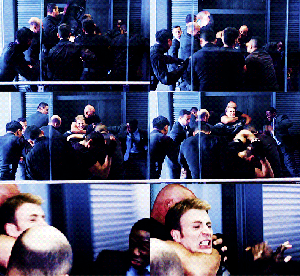
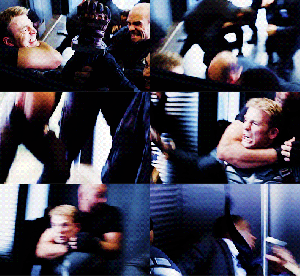
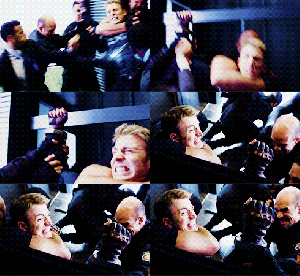
Because he’s so sweet and just GOOD, we forget how ridiculously dangerous Steve actually is. We all ooh and aah over the Winter Soldier and Bucky being a weapon, but he and Steve are essentially the same. The Winter Soldier is nothing but the negative image of Captain America. Steve has EVERY BIT of the capacity to do what Bucky does if not more, he just has the free agency to decide how to use it. And that’s terrifying.
the awesome thing about steve is not his strength, its how he uses it.
It’s not just his strength he uses to such awesome effect. He combines the strength with a hell of a lot of insight and everything he knows about tactics and strategy. Small locked-up spaces? Only got one hand to fight and defend himself with? These guys are his friends or that’s what he thought? Yeah, okay. His mind takes all of that in and processes and then he’s off to the races.
Fuck yeah Steve Rogers.
Amen
I will never stop reminding people that this is the same guy who brought books on military history and defense with him to boot camp. He may not have been able to fight when he came there, but he was reading everything he could about strategy and fighting long before he became Captain America.
Well, to be accurate the Winter Soldier is fucking terrifying because we just saw this scene, wherein Steve was busily being terrifying sex on legs (which, nah man, I never forget)….and then is on pure defensive and still barely holding his own with the Soldier a few minutes of movie later. It’s quite a clever setup.
I love the way they use the fight scenes in this damn movie.
I mean, your whole opening sets us up for this: we *see* how effective Rumlow and team are, and how the techniques they use readily and quietly fell normal men. Then we see how ineffective they are against Steve, which then leads to us seeing how powerful the Winter Soldier *is*.
“… In his backpack there are a dozen notebooks that compose the scattered memories dating back to as far as he can remember which somewhat piece together a scattered life.” – Sebastian Stan
Does anyone knows of a post or someplace where I can read a good and explanatory post of Wakanda? Like, I need background politics, day to day things, anything, headcanons, whatever can make me learn more about t’challa and wakanda in general? I always love to go antropological on things and way more now. There is obviously the: read the comics, which I have already bookmarked to do. But my free time isn’t that high lately. The amount of comics in my wait list is long lol
It changes drastically from writer to writer, so yeah, you will need to read the
comics (at least one or two from each BP era). If you want a summery,
just check out a wiki or database site.
-Kirby era shows the internal lifestyle. -McGregor era shows day-to-day life. -Priest era shows the technological side. -Hudlin era shows the political.
You have no idea how much I appreciate that you took your time to write all this and that you did a summary of things. A thousand Thank you. I’ll check out everything you said.
Also if you want a fast crash course in Wakandan politics and history, BET did an amazing Black Panther animated series of twelve 10-minute interconnected episodes. It was beautifully designed and well-written, focused on Wakanda defending itself from invasion and the political structure of the country.
I should stream that again sometime, it’s not like it takes super long…
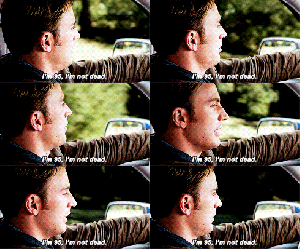
But the real reason I had to chime in was that Steve Rogers is my favorite superhero. Why? Because unlike other patriotism-themed characters, Steve Rogers doesn’t represent a genericized America but rather a very specific time and place – 1930’s New York City. We know he was born July 4, 1920 (not kidding about the 4th of July) to a working-class family of Irish Catholic immigrants who lived in New York’s Lower East Side.[1] This biographical detail has political meaning: given the era he was born in and his class and religious/ethnic background, there is no way in hell Steve Rogers didn’t grow up as a Democrat, and a New Deal Democrat at that, complete with a picture of FDR on the wall.
Steve Rogers grew up poor in the Great Depression, the son of a single mother who insisted he stayed in school despite the trend of the time (his father died when he was a child; in some versions, his father is a brave WWI veteran, in others an alcoholic, either or both of which would be appropriate given what happened to WWI veterans in the Great Depression) and then orphaned in his late teens when his mother died of TB.[2] And he came of age in New York City at a time when the New Deal was in full swing, Fiorello LaGuardia was mayor, the American Labor Party was a major force in city politics, labor unions were on the move, the Abraham Lincoln Brigade was organizing to fight fascism in Spain in the name of the Popular Front, and a militant anti-racist movement was growing that equated segregation at home with Nazism abroad that will eventually feed into the “Double V” campaign.
Then he became a fine arts student. To be an artist in New York City in the 1930s was to be surrounded by the “Cultural Front.” We’re talking the WPA Arts and Theater Projects, Diego Rivera painting socialist murals in Rockefeller Center, Orson Welles turning Julius Caesar into an anti-fascist play and running an all-black Macbeth and “The Cradle Will Rock,” Paul Robeson was a major star, and so on. You couldn’t really be an artist and have escaped left-wing politics. And if a poor kid like Steve Rogers was going to college as a fine arts student, odds are very good that he was going to the City College of New York at a time when an 80% Jewish student body is organizing student trade unions, anti-fascist rallies, and the “New York Intellectuals” were busily debating Trotskyism vs. Stalinism vs. Norman Thomas Socialism vs. the New Deal in the dining halls and study carrels.
You can see he looks apprehensive, stressed right here. And it’s because he hears a siren, presumably police. He’s on high alert because he’s just waiting for the day that those sirens come for him.
And here he is after the (police) car with the siren passes by him. He’s relieved, a little shaken. He swallows, breathes, and gathers himself a little.
ANNNDDD then he spots the guy across the street who’s staring at him, and you can see his stomach drop and he visibly tenses again. It’s a nightmare come to life. And I’m saying “a nightmare” because sadly, this probably isn’t his worst nightmare.
And his breathing picks up, and he looks so afraid, his tiny bit of peace, whatever peace he can get, is shattered. He always knew this day would come, but he had hoped he’d have more time. And it breaks my fucking heart.
And I have to say biiiiiggg KUDOS to Sebastian Stan for acting out all the minutiae of Bucky’s facial expressions and body language. Because HOLY SHIT there was a lot of stuff going on in Bucky’s internal monologue.
I did not deliberately set out to make my past few months’ nonfiction reading into a rec list for a more in-depth look at the political issues addressed in Captain America: The Winter Soldier. Honest. (Mostly honest. The Paperclip book might’ve caught my eye in part because of the shoutout in Cap 2.) But one of the reasons I fell in love with the movie was the great big middle finger it gave the American national-security complex… and then when I was tumbling ever further down the nonfiction rabbit hole and things started sounding eerily familiar, I realized, duh, the scriptwriters for TWS were probably reading a lot of the same books I was.
I don’t make any claim that this is an exhaustive list. As noted, it’s a straight-up list of books I’ve picked up recently, so I have no doubt there are other relevant ones I’m missing. But it’s a pretty solid overview. So without further ado, I give you: the “Actually, a Hydra conspiracy would be less disturbing” national security reading list.
Jane Mayer – The Dark Side: The Inside Story of How the War on Terror Turned Into a War on American Ideals.
Tom Engelhardt – Shadow Government: Surveillance, Secret Wars, and a Global Security State in a Single-Superpower World.
Dana Priest and William Arkin – Top Secret America: The Rise of the New American Security State.
Annie Jacobsen – Operation Paperclip: The Secret Intelligence Program that Brought Nazi Scientists to America.
More detailed writeups and a bit of a rant under the read-more link. (Gist of the rant: The best and scariest thing about Cap 2 is that the most disturbing things about SHIELD/Hydra are 100% based in fact.)
Coming back to this list, I’d also like to add Bruce Schneier’s Data and Goliath: The Hidden Battles to Collect Your Data and Control Your World. Schneier is no paranoid crank or partisan hack; he’s been a well known, widely respected computer security expert since the mid-late 90s, and he has a knack for distilling very technical issues down to the essentials of what it all means and why it matters. He’s also a reliably lucid voice on broader issues of security, risk, fear, the establishment of trust, and the foundations of civil society.
I’m telling you all this because the apocalyptic wasteland described in this book, which will make you want to flush your phone down the toilet and never drive or take public transit anywhere ever again, is actually a pretty restrained take on the situation from a guy who knows what he’s talking about and understands the needs, stakes, and motivations of all parties involved.
(Notably, Schneier does not encourage you to flush your phone down the toilet, or up stakes and move to a bunker in Montana. Part of his point is that if seeing the very tip of the data-exploitation iceberg makes you feel like you have to, something is horribly out of whack and there’s no actual reason Certain Parties need to be given unfettered, unsupervised access to every single thing they ask for.)
Zola’s algorithm is already out there, more versions of it than anyone knows how to count, ticking away in the cloud. To paraphrase a different Schneier quote, it’s bad civic hygiene to sit around waiting for someone to decide that building death helicarriers out of it would be a great way to keep the world safe.


















 Tumblr Exodus