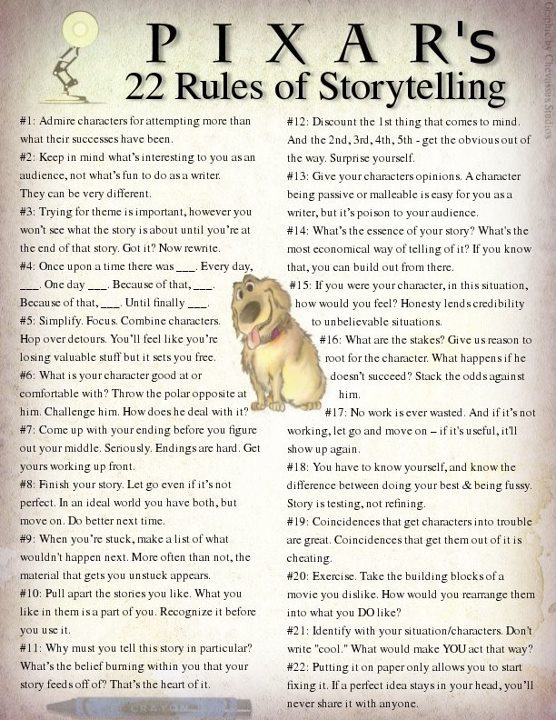
Pixars 22 Rules of Story Telling
9 is worth the price of admission, holy crap.
1. Admire characters for attempting more than what their successes have been.
2. Keep in mind what’s interesting to you as an audience, not what’s fun to do as a writer. They can be very different.
3. Trying for theme is important, however, you won’t see what the story is about until you’re at the end of the story. Got it? Now rewrite.
4. Once upon a time there was ___. Every day ___. One day ____. Because of that, ____. Until finally, _____.
5. Simplify. Focus. Hop over detours. You’ll feel like you’re losing valuable stuff but it sets you free.
6. What is your character good at or comfortable with? Throw the polar opposite at them. Challenge them. How do they deal with it?
7. Come up with your ending before you figure out your middle. Seriously. Endings are hard. Get yours working up front.
8. Finish your story. Let go even if it’s not perfect. In an ideal world you have both, but move on. Do better next time.
9. When you’re stuck, make a list of what wouldn’t happen next. More often than not, the material that gets you stuck appears.
10. Pull apart the stories you like. What you like in them is a part of you. Recognize it before you use it.
11. Why must you tell this story in particular? What’s the belief burning within you that your story feeds off of? That’s the heart of it.
12. Discount the 1st thing that comes to mind. And the 2nd, 3rd, 4th, 5th– get the obvious out of the way. Surprise yourself!
13. Give your characters opinions. A character being passive or malleable is easy for you as a writer, but it’s poison to your audience.
14. What’s the essence of your story? what’s the most economical way of telling it? If you know that, you can build out from there.
15. If you were a character, in this situation, how would you feel? Honesty lends credibility to unbelievable situations.
16. What are the stakes? Give us reason to root for the character. What happens if he doesn’t succeed? Stack the odds against him.
17. No work is ever wasted. And if it’s not working, let go and move on– if it’s useful, it’ll show up again.
18. You have to know yourself, and know the difference between doing your best & being fussy. Story is testing, not refining.
19. Coincidences that get characters into trouble are great. Coincidences that get them out of it is cheating.
20. Exercise. Take the building blocks of a movie you dislike. How would you rearrange them into what you DO like?
21. Identify with the situation/characters. Don’t write “cool.” What would make YOU act this way?
22. Putting it on paper only allows you to start fixing it. If a perfect idea stays in your head, you’ll never share it with anyone.
 Tumblr Exodus