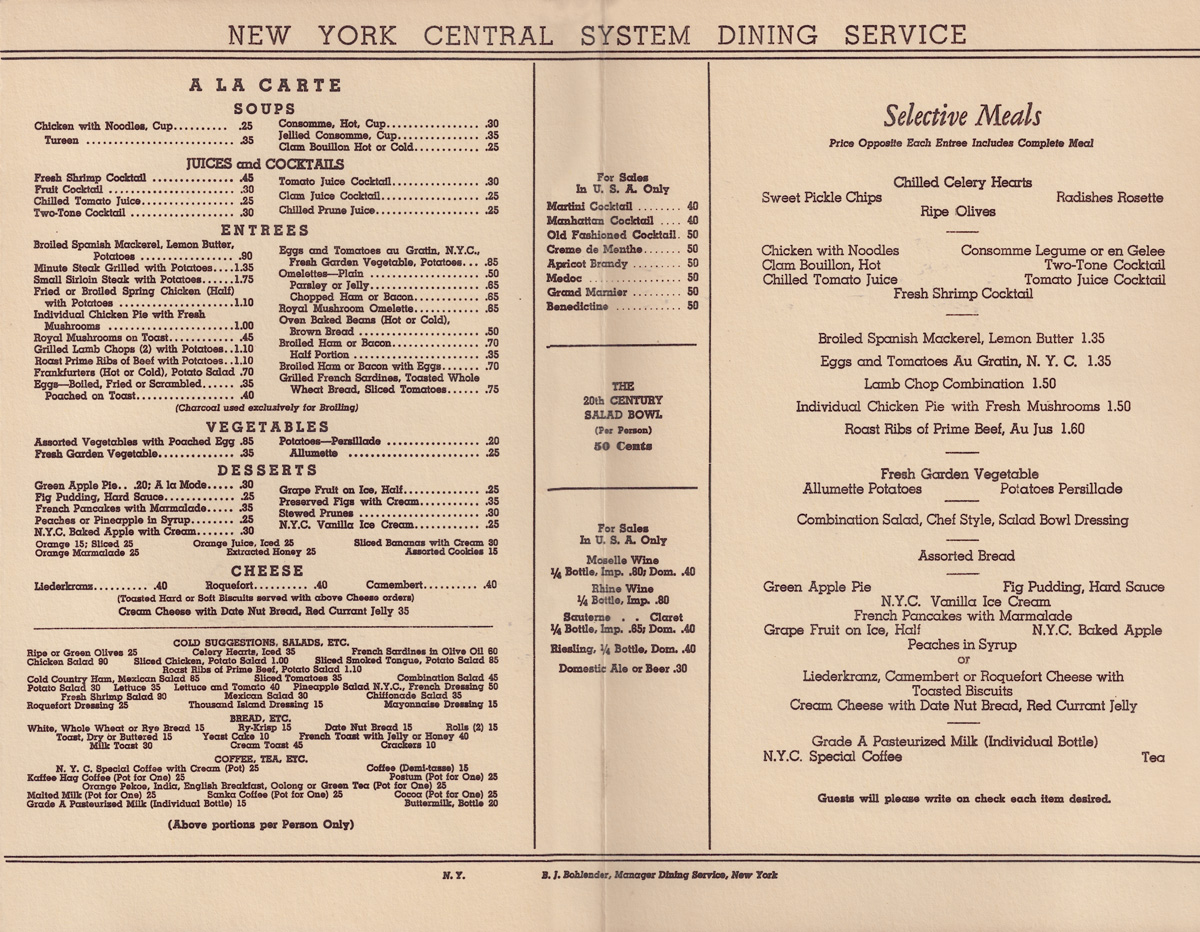
** Permission was granted by the artist to upload this submission! Check out their other amazing work and make sure to give them ten stars!. DO NOT EDIT OR REPOST.**
But the real reason I had to chime in was that Steve Rogers is my favorite superhero. Why? Because unlike other patriotism-themed characters, Steve Rogers doesn’t represent a genericized America but rather a very specific time and place – 1930’s New York City. We know he was born July 4, 1920 (not kidding about the 4th of July) to a working-class family of Irish Catholic immigrants who lived in New York’s Lower East Side.[1] This biographical detail has political meaning: given the era he was born in and his class and religious/ethnic background, there is no way in hell Steve Rogers didn’t grow up as a Democrat, and a New Deal Democrat at that, complete with a picture of FDR on the wall.
Steve Rogers grew up poor in the Great Depression, the son of a single mother who insisted he stayed in school despite the trend of the time (his father died when he was a child; in some versions, his father is a brave WWI veteran, in others an alcoholic, either or both of which would be appropriate given what happened to WWI veterans in the Great Depression) and then orphaned in his late teens when his mother died of TB.[2] And he came of age in New York City at a time when the New Deal was in full swing, Fiorello LaGuardia was mayor, the American Labor Party was a major force in city politics, labor unions were on the move, the Abraham Lincoln Brigade was organizing to fight fascism in Spain in the name of the Popular Front, and a militant anti-racist movement was growing that equated segregation at home with Nazism abroad that will eventually feed into the “Double V” campaign.
Then he became a fine arts student. To be an artist in New York City in the 1930s was to be surrounded by the “Cultural Front.” We’re talking the WPA Arts and Theater Projects, Diego Rivera painting socialist murals in Rockefeller Center, Orson Welles turning Julius Caesar into an anti-fascist play and running an all-black Macbeth and “The Cradle Will Rock,” Paul Robeson was a major star, and so on. You couldn’t really be an artist and have escaped left-wing politics. And if a poor kid like Steve Rogers was going to college as a fine arts student, odds are very good that he was going to the City College of New York at a time when an 80% Jewish student body is organizing student trade unions, anti-fascist rallies, and the “New York Intellectuals” were busily debating Trotskyism vs. Stalinism vs. Norman Thomas Socialism vs. the New Deal in the dining halls and study carrels.
“Dropping the shield is a rejection of the Captain America identity and a choice to embrace the Steve Rogers identity,” Anthony Russo says.
please don’t forget that steve didn’t just drop the shield in cacw to show he’s choosing to protect bucky—he also dropped it to show he’s choosing himself. bucky, and his friendship, and the connection to the past that he represents, is of course an inextricable part of that self. but bucky isn’t the only part.
captain america, the mantle that steve’s worn for so long, is arguably most visible through this shield. it was created for captain america. it is his best and most enduring and most recognizable weapon. the shield represents all the honor of the role, and all the responsibility of the role, and all the heaviness of the role. it’s a literal weight to carry. one that people who matter to steve (natasha, bucky, others) have picked up time to time in battle, a metaphorical sharing of the burden.
make no mistake—steve can carry the weight of the shield. he wears it well. he is captain america, insomuch that captain america is the persona the world needed to give him so he was allowed to use his powers to actually do something. but as soon as this mantle, this title, this legacy, this shield, becomes representative of someone else’s ideals rather than his own, steve makes a decision:
drop it.
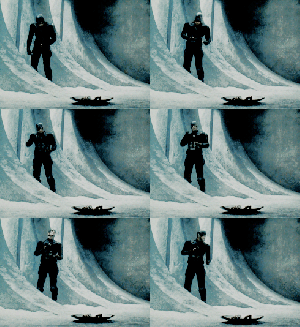
when he leaves the shield in that bunker in siberia, he’s leaving behind a lot of things: his role on a team that felt more like someone else’s family than his own; the identity created for him by 70 years in the ice and never recrafted to fit who steve was when he got unfrozen; the expectations placed on him by the world at large based on that identity; the need to put faith in and take orders from and represent institutions he’s progressively been losing trust in since the WSC ordered a nuke to hit NYC.
when he leaves the shield in that bunker in siberia, he’s leaving behind captain america as the 21st century has created him.
he’s choosing himself. he’s choosing steve. he’s choosing to be steve. free to put faith in people, individuals. free to stand up for what he believes in. free to be flawed. free to explore who steve even is, in this new world.
like i said—it’s huge that steve gives up the shield with bucky’s arm thrown around his shoulder, but that’s because bucky is a part of steve. and steve is the most important thing being reclaimed, defended, and protected in that final scene.
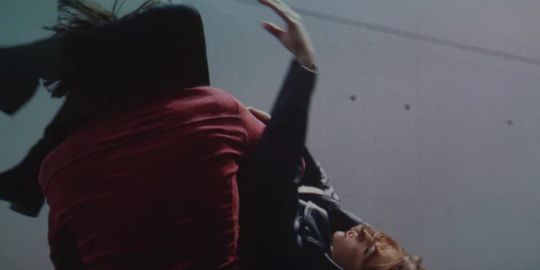
In an interview with Empire Online, Joe Russo said of this scene,
He’s hanging onto that helicopter for an extremely passionate reason. In stories you’ll read where a mother will lift a car
off a child. There’s something very important happening in that scene
and for us it really represented his struggle as a character, one man
pitted against a helicopter that’s trying to take off. Can he stop it?
And what are the limits of his strength?
The
effects of doing this on Steve’s body depend on how much strain is
actually put on his muscles, ligaments, and bones. I don’t recall that
we’ve ever been told the full extent of his strength post-serum in the
MCU (as Joe Russo mentions, this scene is partly an exploration of
MCU!Steve’s abilities), but in the comics he bench-presses around 1,100
lbs:
This
seems about right, or maybe even a little on the low side, considering
his everyday feats of strength in the MCU, such as lifting a motorcycle
with three women on it in CA:FA:
And throwing another motorcycle at his enemies in AoU:
(Psst, Steve, motorcycles are supposed to stay with the wheels on the ground!)
In
order to answer your question, we need to know how much lift the
helicopter can generate vs how much force Steve can apply to it. I know
absolutely nothing about helicopters, but a Bell 429 (which is the
most “helicopter”-looking helicopter I could find on Google) has a cargo
hook capacity of 3,000 lbs, meaning it can take off with 3,000 lbs
suspended below it. So let us assume that Steve is in effect
“reverse-lifting” (pulling down instead of up) 3,000 lbs, which sounds
like a lot, definitely outside his normal capacity.
…Except he’s
not actually doing that, because (as far as I can tell from the
2-second clip) he doesn’t try to pull the helicopter closer to himself
(concentric force), he’s keeping it from flying away (eccentric force).
Because of how muscle fibres work at the molecular level, they can
generate 1.75 times greater force eccentrically than concentrically,
meaning that Steve (at least in the comics) is capable of lifting just
shy of 2,000 lbs eccentrically. That’s pretty impressive!
However,
it’s still less than the helicopter’s 3,000 lbs capacity, so how do we
explain that? Well, Steve isn’t actually pulling eccentrically at the
helicopter by the end of the clip, he’s just holding on to it,
generating static force. This means that his bones and ligaments are now
assisting his muscles to prevent his body from being dismembered. If
you’ve done any weightlifting yourself, you’ll know that your static
strength is much, much larger than either your concentric or eccentric
strength – I’m a total weakling so I can’t do an actual pull-up either
concentrically or eccentrically (feel free to laugh), but I can easily
hang from the pull-up bar, even one-handed, and let my ligaments carry
my full bodyweight with no ill effects.
I don’t know how strong
Steve’s bones and ligaments are, but considering he’s a supersoldier and
nigh on unbreakable judging by his propensity for jumping out of planes
and elevators, I don’t think he’ll suffer any debilitating injuries
from this helicopter stunt – maybe some strains and sprains, and even
so, I bet the movie will show him up and running again shortly
afterwards. 😉
So while it’s definitely impressive, holding down a helicopter trying to take off seems to me to be well within Steve’s
abilities (I was more impressed by the fact that he managed to lift
that steel beam off of Bucky during the fight on the helicarrier in
CA:TWS). Provided Steve can keep a grip on it, of course; helicopters
look pretty slippery. 🙂
To add some extra helicopter- and helicopter-adjacent details and discussion to @wintercyan’s awesome meta:
The situation is probably even more reasonable than @wintercyan lays out, because of the way that helicopters’ ratings are listed, which is a function of how helicopters are used for moving people around versus moving cargo around. [detailed discussion after the read-more!]
What’s cool about that scene is that you can actually see the different kinds of baseline power and skill when each person fights against Bucky! It creates a situation where each superhero, just as they are, has to fight without warning.
Sam gets taken out immediately because the Soldier sneaks up on him. He didn’t get a chance to think or plan, which is how Sam operates in a fight – in CATWS, he came from behind and took out the HYDRA soldiers. But as soon as he’s conscious, Sam makes a tactical decision, just like a soldier: he goes after Zemo, because he knows he can’t take Bucky on without any gear. Sam recognizes the distraction for what it is – Zemo’s escape:
Tony fights intelligently, using the environment to his advantage. He sneaks up on Bucky, uses sonic and flash bombs, and anything he grabs becomes a weapon. He also twists the battle to always centre around his tech, which takes split-second calculations in a fight. But when that tech fails… physically, Tony is just a regular man, and he’s easily defeated.
Then Sharon fights. She’s FBI trained, bold and unafraid, and could easily take down a skilled fighter… but she’s only human, and she’s inexperienced in fighting enhanced beings. She’s also not skilled enough in her fighting style – her movements are more about force (which does nothing to Bucky, being inherently stronger). When she tries to bring Bucky down, Sharon puts her weight onto Bucky’s metal arm, and uses her fists to fight, so Bucky just shakes her off. It’s not enough.
Natasha takes over, and you can see the difference immediately: she’s exceptionally skilled in combat and has been trained to fight enhanced beings. She sneaks up on Bucky while he’s distracted with Sharon, hitting vulnerable areas and then backing out of his range. Natasha uses her Widow move, coming at Bucky from behind, using his human arm for leverage so he can’t toss her off, and she gets quite a few hits to Bucky’s head using her elbows, not her fists. Nat isn’t enhanced, but she’s holding her own… until Bucky defeats her with the metal arm. But I find their fighting styles to be eerily similar.
T’Challa then enters the fray. It’s now Enhanced vs Enhanced, and you can see how the playing field levels in terms of physical strength: T’Challa’s punches are more effective, and his hits cause Bucky to stumble. But T’Challa underestimates Bucky’s strength, likely because he’s never fought The Soldier before now. He’s also inexperienced compared to Bucky, because he’s young and new at this; you can see him experimenting in his attempt to subdue Bucky. It’s a time-consuming fight, but Bucky would have won in the end. So there’s potential – T’Challa thinks on his feet and is a skilled fighter – but without the suit, he’s not quite there yet.
And, like all of them, T’Challa is only trying to detain Bucky, not kill him… but the Winter Soldier is willing to kill them, and that makes a huge difference. The caged animal is always going to be stronger and more volatile, and that automatically gives Bucky an edge.
What the Winter Soldier doesn’t realize, though, is that Steve is in the same boat; he doesn’t care what has to be done, as long as he gets Bucky back. After he gets over the initial shock of Bucky’s mindcontrol, Steve is a formidable opponent: he’s enhanced, he’s skilled, he’s experienced, he’s familiar with the Soldier’s fighting style… but mostly, he doesn’t care if he lives or dies. He’ll go down with Bucky if that’s what it takes. And that’s where Steve wins over the Soldier: his love for Bucky gives him that upper hand.
(Okay, I went off on a tangent. But I just really like that scene!)
This is an indexed Masterpost of all the recipes that appear in the Recipe Wednesday posts from @steve-rogers-new-york. Unlike the previous Recipe Wednesday masterlist, this version is ordered by the recipes themselves. Each recipes is grouped and sorted based on food type, then linked to the post they appear in.
The below are the real period recipes that have appeared in the weekly Recipe Wednesday posts, each taken from the Brooklyn Daily Eagle— a local newspaper that would have been accessible to Steve, his mother, and Bucky during their time in Brooklyn. The recipes range in content from dinner meals, snack, condiments, and desserts — and feature an image of the recipe as it appeared in the newspaper, a link to the digitised copy of the paper, and transcriptions of the recipes.
I LOVE THIS YOU CAN’T KNOW HOW MUCH. So much of the kinds of things they ate are like SO DIFFERENT than now, and I can just vaguely have some kind of long-distance-call telephoning to this in my own life, when you know, like, fruit cups with no fresh fruit in them and sort of eggs and noodles TOGETHER were still served! Like, NYC diners still served this food for a long long time afterwards and just the names of the dishes bring me right back there I mean the upside down cakes and the Stroganoffs, ffs. I think I posted at some point some of the real menus for the 20th century limited; so awesome. Thank you @steve-rogers-new-york!
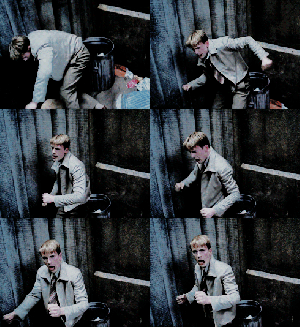
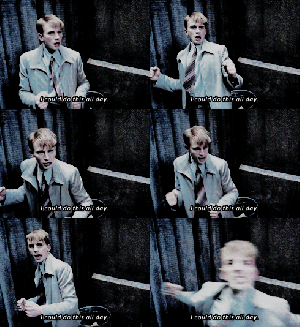
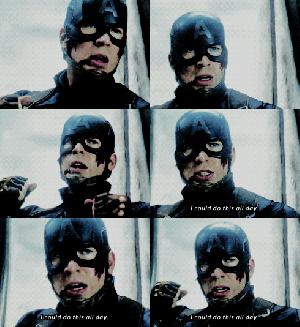
Something that had already caught my attention when I first watched Captain America: Civil War, and that now receives my full love, is the scene at the end of the movie when Steve says “I can do this all day” once Tony tells him to surrender. While it is cool in itself that it mirrors skinny Steve from the 1940s, it is cooler to me for another reason.
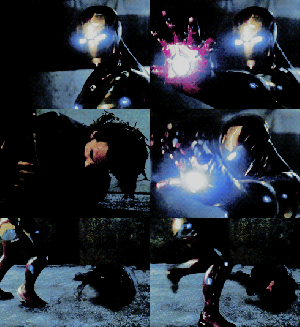
As soon as Steve says “I can do this all day”, a heavily beaten Bucky lying on the floor, and devoid of his metal arm reaches for Tony’s leg, to stop him from hitting Steve. This mirrors the real Bucky, the guy who befriended Steve when both were children, the guy who always got Steve’s back, who didn’t care about Captain America but for the little guy from Brooklyn who was too dumb to run from a fight.
To me that’s the crucial Bucky moment of the whole movie. That’s the moment when you know why Steve is fighting for Bucky. Inside of that broken, pretty dehumanised man, is still that kid from Brooklyn who couldn’t bare to see his best friend hurting.
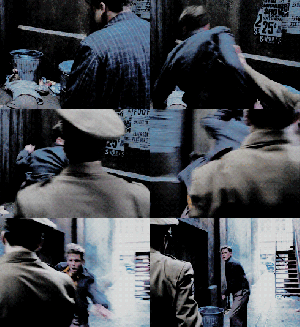
The follow up of the “I can do this all day” scene in Captain America: the First Avenger is this:
They did go to the future. Yes, things changed and both of them changed, but at the same time they are still the same. The tiny, skinny, sickly kid who would never run from a fight, and his best friend, who would be with him till the end of the line.
Some time ago there was a post on my dashboard saying that the Captain America trilogy is beautifully symmetric, for Steve Rogers picked up the shield for Bucky and gave the shield up for Bucky, becoming Captain America and retiring from that position because of his friend. But to me that’s not it.
To me this trilogy is beautifully symmetric because of those two mirroring scenes I talked about above. Because Steve Rogers can expend his whole day, not to say his whole life, fighting for what he believes is right, and Bucky Barnes will always get his back, till the end of the line. Be it in the 1940s or the 21st century.
Captain America is Steve Rogers. A shield doesn’t make him. Being able to “do this all day” is what makes Captain America, be it in the past or in the future. From beginning to end Steve Rogers is not a perfect soldier, but a good man. At the same time, Bucky Barnes is not what Hydra made of him, what it made him do. He isn’t just a perfect soldier. Inside the perfect soldier “ready to comply” has always been trapped a good man.








 Tumblr Exodus