Arawn
Hir yw’r dydd a hir yw’r nos, a hir yw aros Arawn
(Long is the day and long is the night, and long is the waiting of Arawn.)
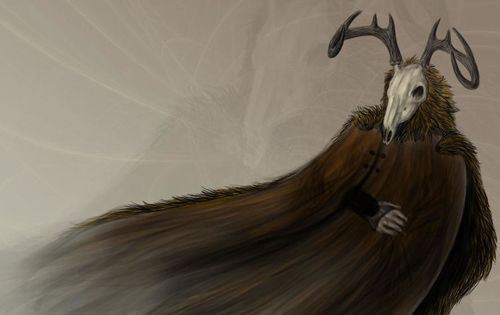
Arawn is a Welsh mythological figure who was the king of Annwn before Gwyn ap Nudd took the throne. I like to think he retired more than he died because, hey, even kings of the Underworld must get tired of their jobs sometime, right?
He features prominently in the First Branch of the Mabinogion. Pwyll, prince of Dyfed, is out hunting one day and he finds another pack of hounds feasting on a dead stag; he chases them off and allows his own dogs to feed from it. First thing to note is that, while perfectly nice, Pwyll does lack foresight and common sense. He can be kind of dumb. He looks at the other dogs and realises, “Well, shit, these are some weird fucking dogs.” Because really, what kind of normal dogs are shining white with blood red ears? He chases them off anyway.
Enter Arawn.
He gets kind of passive aggressive with Pwyll, telling him, “I know who you are but I’m not talking to you because you have offended me!” He doesn’t actually tell Pwyll what he’s done wrong until Pwyll, nice bloke he is, asks. (It also has to do with the fact that Arawn is of higher rank but he doesn’t actually tell Pwyll this until after Pwyll’s promised to pay him back.) So he tells Pwyll that, in order to make up for this offence, Pwyll has to go to Annwn disguised as Arawn for a year and kill this guy called Hafgan for him. In return, to avoid suspicion, Arawn will pretend to be Pwyll. They do this and, at the end of the year, Arawn is astounded to hear that not only has Pwyll been a good fucking king, he also hasn’t had sex with Arawn’s wife so she’s still seen as faithful to him. He thinks, “I’ve got a good fucking friend here.”
After Pwyll kills this guy for him, Arawn and Pwyll just keep getting closer and closer as chums. They send each other presents, like hawks and horses and hounds. They are so chummy by the end of this bit of the branch, that Pwyll drops the “prince of Dyfed” part and instead becomes known as “Pwyll Pen Annwn” instead (Pwyll, head of Annwn basically.)
Nice.
He kind of falls out of the Mabinogion from here on out. He’s referenced in the Fourth Branch, when Pryderi (Pwyll’s son, who really deserves his own post) basically tells Gwydion, “I’m not giving you these pigs for free; Arawn says I can’t.” But apart from that…eh, Arawn? Who’s Arawn? Some people think that a large part of the First Branch is actually missing, and that maybe Arawn is more closely linked to Pwyll’s marriage to Rhiannon and Pryderi’s conception than is actually indicated. Which, if that is the case, is fucking heartbreaking. The friendship between Arawn and Pwyll’s family is very long lived, and the gift of pigs to Pryderi probably indicates some incredible longevity (if not outright immortality) on Arawn’s part because by the time of the Fourth Branch, Pwyll is long dead and I’d imagine Pryderi at least pushing forty by this point because of the all the shit that went down between First and Fourth.
He pops up again in the Battle of Trees, because Gwydion’s brother Amaethon is nearly as much of a shit as Gwydion himself and steals a dog, a deer and lapwing from Arawn. Arawn and Amaethon do fight it out, but Gwydion fucks it up by animating an entire forest to act as his army and ultimately wins on behalf of his brother by guessing the name of one of Arawn’s men. This probably isn’t the end of Arawn but it may well have been the point where he threw up his hands and said, “That’s it! I’m done! Gwyn, you take over!”
Arawn’s most prominent reference in modern pop culture is in Lloyd Alexander’s Chronicles of Prydain, where he is the lord of death who is determined to fuck shit up in Prydain to the point no one can save it. His foe is, again, Gwydion. It’s actually quite interesting that Arawn’s name is given to an antagonist when, by all accounts, Arawn is a much much better person than Gwydion will ever be. Seriously, Gwydion’s a fucking dickhead. The reason is probably because death = evil, as well as the fact that the Christianisation of the myths often translated, or just plain referred to, Annwn as “Hell” when it was actually closer to the paradise of Heaven. Which might have something to do with the fact that Annwn was sometimes described as being underground.
But that, my friends, is a story for another time.
 Tumblr Exodus
